


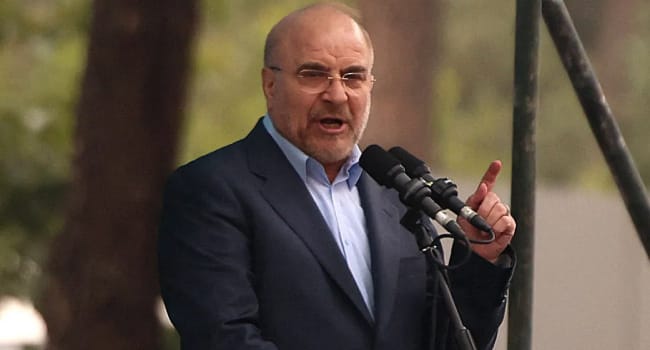
Iran’s top negotiator, parliament speaker Mohammad Bagher Ghalibaf, said Tuesday that the strategic Strait of Hormuz will remain closed until the United States meets a set of demands Tehran says Washington agreed to under a truce reached in June, one that has since collapsed. “I want to state clearly that the Strait of Hormuz will not be opened until the American commitments stipulated in the memorandum of understanding… are implemented,” Ghalibaf said in a speech broadcast on state television.
He listed the removal of the naval blockade, the lifting of oil sanctions and the unfreezing of Iran’s assets abroad among the demands, which were included in the Iran-US truce reached in mid-June before it later fell apart.
Ghalibaf added that Washington’s obligations also included “ending threats and military operations on all fronts,” telling a parliamentary session that the waterway, critical to global energy trade, would stay shut for as long as the US failed to honour the agreement.
Under the terms of the now-expired memorandum, the US had agreed to issue waivers permitting the export of Iranian crude oil, petroleum products and derivatives once sanctions were lifted, in addition to unfreezing Iranian funds and assets. In return, Iran agreed that it “shall not procure or develop nuclear weapons,” with both sides also agreeing to hold further discussions on enrichment tied to Iran’s stated nuclear needs. A 60-day window intended for continued negotiations under the framework expired on Monday.
The renewed standoff comes against the backdrop of a conflict that has repeatedly flared in and around the strait in recent months. War between Iran and the United States broke out on February 28 following US-Israeli attacks on Iran, triggering conflict across the region. Diplomatic efforts since April 8 have ended the most intense bombardments, though sporadic clashes have continued, particularly around the Strait of Hormuz.
Tensions escalated again in early July, when Iranian forces fired on commercial vessels transiting the strait, prompting intensive US military bombardment of Iran’s southern coast. Iran responded by striking US bases and energy installations across Gulf states.
The dispute took on fresh urgency Tuesday after an unidentified projectile struck a ship attempting to transit the strait off the coast of Oman, damaging the vessel’s engine room and resulting in a crew casualty, according to the UK Maritime Trade Operations agency, which cited a report from the ship’s security office.
Despite the impasse, Iran and Oman, both coastal states along the strait, have spent weeks discussing the future of navigation through the waterway, with Tehran saying the geographic coordinates of a proposed route have already been agreed upon. On Monday, Iran said talks were “continuing in a serious manner,” with both sides exchanging views on the text of a possible joint statement.
US President Donald Trump has called on Tehran to surrender in a conflict that has become a growing political burden domestically, while Ghalibaf, in his address, said Iran remained “ready to inflict an even more crushing defeat on the enemy, proportionate to its actions and advances.”
The standoff has already rattled global energy markets, with oil prices climbing to their highest level since July as traders’ hopes for a swift resolution to the US-Iran conflict continue to fade.
The tension in the Gulf has also drawn in other regional actors, with Yemen’s Iran-backed Houthi forces saying they had again targeted a Saudi Aramco refinery on the Red Sea coast, as clashes near the Bab al-Mandeb strait intensify following a Houthi-declared blockade of Saudi shipping.
With neither side showing signs of backing down and the strait — a corridor for roughly a fifth of the world’s seaborne oil — remaining a flashpoint, the standoff threatens to prolong instability in one of the world’s most critical energy chokepoints.