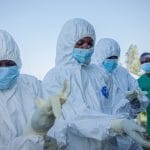




The World Health Organization says the Democratic Republic of Congo urgently needs about 5,000 additional health workers as overwhelmed facilities struggle to cope with the country’s rapidly expanding Ebola outbreak.
Health workers in Personal Protective Equipment (PPE) practice safety check protocols on each other during a training by medical charity, Médecins Sans Frontières (MSF) to reinforce regional emergency response capacity for Ebola in the Democratic Republic of Congo (DRC) at Ongata Rongai, Kajiado County in Kenya on July 10, 2026.
The World Health Organization (WHO) said on Tuesday it needed 5,000 extra health workers to help tackle the highly contagious Ebola virus in the Democratic Republic of Congo (DRC).
The outbreak, officially detected in mid-May, has spread to six provinces in the country’s conflict-plagued east and northeast.
Since May 15, the virus has killed 3,175 people among the more than 6,600 confirmed infected, the WHO said, citing official Congolese figures.
Health services lack sufficient staff and resources and have been overwhelmed by the surge in cases of Ebola, which is transmitted through contact with bodily fluids and can cause severe internal and external bleeding and organ failure.
The WHO said it hoped to create 3,000 beds for patients in Ebola treatment centres in the DRC.
With three medical staff needed for each patient, that means training 9,000 health workers, said Luca Fontana, a senior technical official with the United Nations’ health agency.
“More than 900 beds have been built within the first two months of the response, and we have now reached close to 1,400 beds across 59 treatment centres,” he told a press briefing in Geneva.
“Despite this extraordinary effort, we estimate that another 1,600 beds will be required to meet the rapidly growing needs,” he continued.
“Right now we have nearly 4,000 healthcare workers currently working inside the treatment centres. So it means we need 5,000 more.”
Fontana said the health ministry in Kinshasa was racing against time to find suitable medical staff in other regions to bring into the Ebola-affected provinces.
“The problem is to identify those fast enough to make sure that we can cover the growing need,” he explained.
“Every treatment centre that is fully staffed and functional means more life saved and a stronger chance of bringing this outbreak under control.”
The current Ebola epidemic is caused by the Bundibugyo strain, for which there is currently no approved vaccine or treatment. Several treatments and vaccines are being tested.
It has hit regions in the north and east where the presence of the state is weak, health infrastructure is largely lacking, and myriad armed groups have roamed for decades.
Fontana said that while in the initial stages, most patients admitted to treatment centres came from Bunia, the capital of Ituri province, sick people were now arriving from villages “far beyond” the epicentre.
This was “a clear sign” that the outbreak is spreading and the WHO response “must adapt”, he stressed.
Ebola has killed more than 15,000 people in Africa in the last 50 years.
The worst outbreak previously recorded in DR Congo killed nearly 2,300 people of the 3,500 reported infected between 2018 and 2020.
AFP