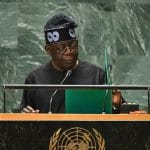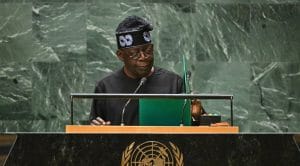




President Bola Ahmed Tinubu
The Onimeko of Imeko, Oba Benjamin Alabi Olanite Oyeditan, has called on the Federal Government to establish higher education and healthcare institutions in the border community, saying its historical importance as a frontier headquarters has not been matched by adequate infrastructure.
The monarch made the call ahead of this year’s Agbinrekoti Festival, which he said would provide an opportunity to preserve Imeko’s cultural heritage, draw attention to its development needs and strengthen ties with Ketu communities across the border in the Republic of Benin.
According to Oba Oyeditan, Imeko was the headquarters of the Western Frontier Preventive Service established in 1899 and historically served as a frontier centre covering the area from Badagry to Shaki.
He said the town’s strategic location and its long association with the Customs Service, immigration, police and other border agencies justified greater federal investment.
“We are the border going to people across into Benin Republic. We have Customs, Police, Soldiers, Immigration, we have all of them,” he said.
He called for the establishment of a Federal Medical Centre in the community, arguing that Imeko’s status as a border town made such an institution necessary.
He also appealed for the establishment of a Federal College of Agriculture and Development Studies in Imeko, noting that the area was predominantly agrarian and had historically relied on communal and missionary efforts to provide primary and secondary education.
Oba Oyeditan urged the Federal Government to consider a bill sponsored by Senator Solomon Adeola, popularly known as Yayi, seeking the establishment of the institution.
“Being a border community, being a border headquarters, the first frontier headquarters in what is known as Nigeria today, Imeko deserves Federal Government establishment of a higher institution of learning. ”
The traditional ruler also renewed his call for the rehabilitation of Federal Road 102, which links Abeokuta and Imeko, describing it as an important international route.
He further appealed for the construction of an additional 15-kilometre link connecting Imeko to the newly approved frontier road corridor.
He noted improved road infrastructure would boost agriculture, facilitate movement of goods and encourage industrial investment in the area.
“The road has opened the place up,” he said. “All our agricultural produce that used to get spoiled before, we now have access road either to the north or to the rest of the southern part.
“Even people that want to locate
factories, the road is now available. Land by the roadside can be purchased or leased; they can site their factories.”
Festival rooted in history
The monarch said the Agbinrekoti Festival was conceived to preserve the history and cultural identity of Imeko.
He explained that the celebration was originally known as Imeko Day before he ascended the throne and that he subsequently commissioned research to establish a historically significant date for the annual event.
According to him, research conducted in archives and libraries led to the adoption of September 21, replacing the December 25 date previously used for Imeko Day.
He maintained that the festival was rooted in the history of Imeko and its people, including the destruction of the town by Dahomean forces in the 19th century and the subsequent return of displaced inhabitants
The monarch said the festival would also help younger generations understand their history and traditions.
“This festival will let them know the kind of food their forefathers ate, where they are coming from, the kind of work they did before,” he said.
“It preserves our identity — how we fed ourselves before colonial masters, how we governed ourselves, who was in charge of community safety and security, our music, our dance, our food.”
A major feature of this year’s festival, he said, would be a fundraising drive for the construction of a civic and resource centre incorporating a library.
Oba Oyeditan said the project was intended to encourage reading among young people at a time when electronic devices were increasingly competing for their attention.
Ketu communities to attend
The festival will also host, for the first time, representatives of Imeko Ketu in the Republic of Benin.
The monarch described the visitors as part of the wider Ketu community, linked to Imeko by a shared history and cultural heritage.
“They are coming home to their source,” he said, adding that the visitors would showcase music and cultural traditions that had developed on the other side of the border.
Customs, border tie, and security
The monarch also spoke about tensions that sometimes arise between border communities andcustomss officials, linking some of the difficulties to the history of the Ketu people.
He said the traditional Ketu kingdom was divided by colonial boundaries between what later became Nigeria and the Republic of Benin.
According to him, Imeko residents and Ketu communities across the border continued to regard themselves as part of the same historical and cultural community, despite the international boundary.
He further stated that this sometimes complicated enforcement of restrictions on the movement of goods and people.
“If I go to Alaketu and I’m coming and Alaketu says, ‘These are two bags of rice, give to the Olori,’ when the Customs sees me, they say I have become a rice crosser, so I’m a smuggler. How could I be a smuggler within my own kingdom?” he asked.
The monarch, however, said Imeko had maintained a peaceful relationship with security agencies and that traditional leaders intervened whenever disputes arose.
He said the community had also worked with authorities to improve security following incidents of kidnapping in the wider Imeko-Afon area.
According to him, the government subsequently established an Area Command, while additional police divisions were created in Afon, Ilara and Iwoye-Ketu.
He said efforts were also made to restore a military presence in Imeko, resulting in the deployment of a company of soldiers to the community.
“Since then nobody has entered the town to kidnap in the entire Local Government. So security now is okay in Imeko,” he said.
‘We are not where we were yesterday’.
Reflecting on his 12 years on the throne, Oba Oyeditan said his administration had focused on protecting the community’s land and history while pursuing development through government and private initiatives.
“We are not yet there but we are not where we were yesterday. We keep moving, we are not stagnant,” he said.
He described his leadership style as liberal, saying he preferred consultation to authoritarian decision-making.
“There is no how — I am such a leader that I’m not an autocratic or authoritarian leader. I’m a liberal leader,” he said.
The monarch also raised concerns over what he described as government interference in the traditional institution, particularly the creation of new crowns without clearly defined jurisdictions.
He traced one of the disputes involving Afon to the early 20th century, saying his great-grandfather, Akonku II, Obadududulu, installed the first Baale in Afon in 1905.
He said subsequent political developments resulted in the recognition of a crown for the area without adequate boundary demarcation, contributing to later disputes.
Oba Oyeditan said he had pursued dialogue rather than prolonged litigation in resolving the matter.
“What we cannot resolve ourselves is what the third party wants to resolve for us,” he said.
Tinubu, development projects
The monarch commended President Bola Ahmed Tinubu’s administration over the Sokoto-Badagry road project, which passes through Imeko-Afon Local Government Area.
He said the project had the potential to transform the local economy by improving the movement of agricultural produce and attracting investment to previously isolated communities.
“I really thank God for President Bola Ahmed Tinubu’s administration. We could have remained at the backyard of the world if not for him. The Sokoto-Badagry road project is not a small project .”
Oba Oyeditan also acknowledged interventions by the Ogun State Government in addressing teacher shortages in schools in his domain, as well as efforts by Senator Adeola to support development projects in the area.
He maintained that further investment was needed in education, healthcare and roads.
The monarch said the festival would therefore serve a dual purpose: celebrating Imeko’s heritage while drawing attention to the development challenges confronting the community.
“The importance is to preserve our culture and to draw the attention of the world, Federal Government, State Government and who is who to Imeko people and Imeko land,” he said.