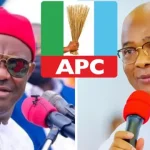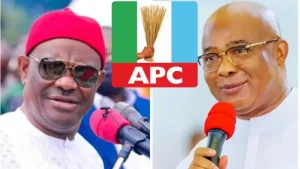



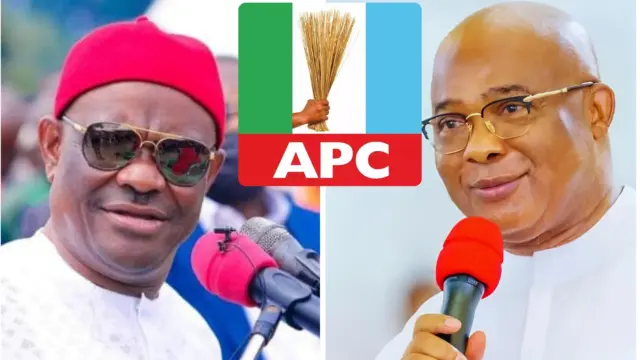
The battle for the All Progressives Congress (APC) ticket for the Imo West Senatorial seat has again pitted Governor Hope Uzodimma and Rochas Okorocha against each other. The undercurrent is the ruling party’s interest in the South-East ahead of the 2027 polls, LEO SOBECHI reports.
The late Abba Kyari, Chief of Staff to former President Muhammadu Buhari, set the tone for the APC’s effort to make political inroads into the South East, then seen as a belated attempt at national inclusion.
Kyari, who was reportedly nursing a presidential ambition ahead of the 2023 election on the APC platform, had urged the region to vote massively for the ruling party, arguing that such support would strengthen its case for a Nigerian president of Igbo extraction.
At the time, the Buhari administration was displeased with Imo State governor Rochas Okorocha for challenging the President in the APC presidential primary ahead of the 2015 general election.
As Okorocha prepared to leave office after two terms and move to the Senate, the Presidency needed an ally capable of retaining Imo, the South East’s most populous state, for the APC.
Hope Uzodimma, who had defected from the Peoples Democratic Party (PDP) alongside his political ally, Senator Ali Modu Sheriff, fitted the bill. Okorocha’s determination to install his son-in-law, Uche Nwosu, as his successor, while retaining influence in the Senate, provided an opening for Uzodimma’s governorship ambition.
With Kyari’s backing, Uzodimma contested the 2019 governorship election on the APC platform after emerging from a parallel primary conducted by the party’s late electoral panel chairman, Ahmed Gulak. Nwosu, whose claim to the APC ticket was also in contention, defected to the Action Alliance (AA), where he became the governorship candidate.
As preparations for the 2027 general election gather momentum, the two Imo political heavyweights are again locked in a battle over the state’s political future. Okorocha, who lost his bid to retain the Imo West Senatorial seat in 2023, is challenging the governor’s political dominance. He blames Uzodimma for frustrating his ambition to install Nwosu as his successor.
Had Nwosu not withdrawn his case challenging Uzodimma’s emergence as the APC candidate, he might have benefited from the Supreme Court’s January 14, 2020 judgment, which declared Uzodimma the winner of the March 9, 2019 governorship election.
Like Okorocha in 2019, Uzodimma is seeking to use the advantages of office to secure a return to the Senate in 2027. But the plan has generated fresh tensions.
His reported proposal to have his deputy, Lady Chinyere Ihuoma Ekomaru, resign to pave the way for a preferred successor has reportedly met resistance from her supporters and the governor’s political adversaries, including Senate President Godswill Akpabio, Senator Adams Oshiomhole and Minister of the Federal Capital Territory, Nyesom Wike. The dispute has therefore become a test of influence.
Court ruling alters political calculations
THE Federal High Court judgment of October 28, 2026, which nullified Uzodimma’s victory in the APC primary for Imo West Senatorial District, has given Okorocha fresh political momentum.
After keeping a relatively low media profile, the former governor began a series of television appearances, revisiting events that preceded his departure from Government House, Owerri. He also accused the chairman of the Progressive Governors Forum (PGF) of never winning an election transparently.
To those familiar with the Presidency’s influence in Imo politics, Okorocha’s renewed visibility appeared to signal a possible shift in the Tinubu administration’s calculations. President Bola Tinubu, who had his own disagreements with the Buhari Presidency, is believed to have reasons to reconsider the political leadership of the APC in the South East.
At the height of the dispute over the senatorial ticket, the Presidency’s efforts to broker peace between the two politicians reportedly failed. Uzodimma was said to have rejected a proposal that would have required him to choose between determining his successor in 2028 and returning to the Senate.
Following the failed reconciliation effort, Tinubu was reportedly of the view that Okorocha deserved recognition as one of the APC’s founding figures in Imo. The former governor had participated in negotiations that brought a faction of the All Progressives Grand Alliance (APGA) into the merger that produced the ruling party.
Beneath the apparent effort to accommodate Okorocha, however, was the lingering question of Uzodimma’s loyalty during the 2022 APC presidential primary. The Imo governor had supported the unsuccessful effort by Buhari loyalists, including Senator Abdullahi Adamu, to secure the Senate President Ahmad Lawan’s ticket.
Although Uzodimma subsequently aligned with Tinubu’s campaign and reportedly contributed N1 billion to its activities, his earlier position remained a source of suspicion among some members of the President’s camp.
The governor nevertheless strengthened his standing in the party. After succeeding Okorocha as chairman of the PGF, he used the position to expand his influence and later emerged as Director-General of the Renewed Hope Ambassadors. He also cultivated allies within the APC National Working Committee (NWC) and supported retaining the party’s zoning arrangement for key elective positions.
Party insiders claim that part of his negotiations involved securing Tinubu’s commitment to the South East producing a principal officer of the National Assembly, an arrangement likened to the political accommodation extended to the region during the Olusegun Obasanjo administration.
In pursuing this objective, Uzodimma has had to contend with political interests on several fronts.
Although Okorocha has not openly declared an ambition to become Senate President or occupy another National Assembly leadership position, his remarks on Channels Television’s Politics Today suggested an interest in the same opportunities being pursued by the incumbent governor. He said that even if he wanted the same position, he would not approach the matter as Uzodimma did.
Okorocha had challenged the declaration by the APC Senatorial Primary Election Committee that Uzodimma won the direct primary, insisting that he secured the majority of votes cast. He also questioned the governor’s eligibility to contest the senatorial election while still in office, citing Section 182(1)(g) of the Constitution.
In its judgment, Justice Egwuatu declared Okorocha winner of the primary and the authentic APC candidate for Imo West. The court granted his reliefs, restrained Uzodimma from parading himself as the party’s candidate and directed the Independent National Electoral Commission (INEC) to recognise him.
Reacting, Okorocha described the ruling as a victory for democracy, the judiciary and the people of Imo West. In a statement issued by his Senior Special Assistant on Media, Sam Onwuemeodo, he said the jubilation that greeted the judgment would not be taken for granted.
He also thanked Tinubu for providing what he described as an enabling environment for the judiciary and other institutions to function, and commended Uzodimma for being among the respondents in the case.
The dispute extends beyond the senatorial ticket. With the APC determined to retain its zoning arrangement for National Assembly leadership positions, Uzodimma’s return to the Senate has been linked to wider calculations over the Senate presidency, currently occupied by Akpabio.
Supporters of the governor claim the South-East was promised a significant leadership position as an
incentive to support Tinubu’s second-term ambition rather than Peter Obi’s presidential aspiration.
Rainbow Coalition widens political contest
When Okorocha appeared on Arise News’ Prime Time last Thursday, he praised the Wike-led Rainbow Coalition for Tinubu’s re-election and pledged to advance its objectives and mobilise votes for the President in Imo.
The appearance revived memories of his political relationship with Wike, particularly a public display of friendship that has acquired fresh significance amid the rivalry between the Rivers politician and Uzodimma.
Towards the end of his second term as Rivers governor, Wike invited Okorocha to the commissioning of the Rumueche-Rumuakunde-Ohna-Awuse Road in Emohua Local Government Area. At a reception in Port Harcourt, Okorocha, seated beside his host, rose to dance to a local tune, drawing Wike into the performance.
Beyond the public display of friendship, political observers in the South-East and South-South regarded both men as influential and combative politicians known for assertive approaches to political contests.
At the event, Okorocha hinted that politicians across party lines were considering a new movement to rescue the country. He said progressive Nigerians should come together to make the country work, arguing that good and bad politicians could be found in both the APC and PDP.
He also urged the South-East and South-South to build on their cultural affinities for greater political and socioeconomic cooperation, adding that an alliance with Wike and other like-minded politicians could make a difference.
Okorocha as alternative political salesman
Some APC stakeholders believe Okorocha could be a more effective mobiliser than Uzodimma for Tinubu’s re-election in the South-East.
Party insiders claim the Presidency has been uncomfortable with what they regard as the governor’s reluctance to openly challenge Obi’s presidential ambition.
There are also claims that it was displeased with Uzodimma’s role in the emergence of former Minister of Science and Technology, Uche Nnaji, as an APC political figure, particularly following controversies over Nnaji’s academic credentials.
During his television appearances, Okorocha focused on Obi’s commitment to a single-term presidency and criticised Uzodimma’s political style. He portrayed himself as having greater grassroots appeal than the incumbent, whom he accused of spending more time in Abuja than maintaining contact with Imo people.
Some Presidency insiders believe Okorocha’s influence could provide a rallying point for APC stakeholders in the South East, including former governor David Umahi and Deputy Speaker of the House of Representatives, Benjamin Kalu, as well as political allies in the Rainbow Coalition, such as Governors Chukwuma Soludo and Alex Otti.
The Presidency has reportedly been concerned about the absence of a broadly accepted political leader capable of coordinating the APC’s interests across the South East. Some party stakeholders accuse Uzodimma of concentrating more on projecting himself as a regional leader than strengthening the party’s grassroots appeal.
Okorocha’s record in building the APC in the region is often cited in this regard. Shortly after the party’s formation, he tried to bring Ebonyi State into its fold, but the initiative brought him into conflict with the late Dr Ogbonnaya Onu, a prominent party leader and Buharist.
Although the APC fielded Barrister Julius Ali Ucha as its governorship candidate in the 2015 election, Onu’s influence limited Okorocha’s efforts to extend his political reach into Ebonyi.
Like Uzodimma, Okorocha maintains relationships across the North. His fluency in Hausa is regarded by some party figures as an additional advantage in his dealings with influential northern politicians.
The challenge for the APC is to convert these relationships into votes in a region where Obi retains considerable political appeal. Signs of the difficulty emerged last weekend when Anambra State Governor Soludo, a leading advocate of Progressives Working Together (PWT), convened the inaugural meeting of the Tinubu re-election campaign structure in the state.
In a post on X, Soludo described the contest as “a battle for the soul of Nigeria, for Ndigbo, and for Anambra”. He argued that politics should be guided by reason rather than emotion and recalled that Igbo leaders, from Zik to Ekwueme and Okadigbo, had played politics at the national centre.
“We cannot afford to be insular,” he added.
However, the absence of prominent APC figures in Anambra, including former governor Chris Ngige and Senator Joy Emordi, raised questions about the level of support for the initiative among established party stakeholders.
Ultimately, the contest between Okorocha and Uzodimma is about more than who secures the APC ticket for Imo West. It reflects the struggle for influence within the ruling party and its search for a credible leadership structure capable of improving its electoral fortunes in the South East ahead of 2027.