



A deeply divided electorate will choose Colombia’s next president in a runoff on Sunday that pits a progressive against a conservative outsider, with both candidates tapping into fears of a renewed internal conflict in the country as they represent “two very extreme sides,” one Colombian said.
“Right now, what worries me is the polarization that exists between us: there are two very extreme sides, and the violence is concerning,” said John Manrique, a lawyer in Colombia’s capital, Bogotá. “What I hope is that people accept who won … Let’s not go out and fight.”
Colombians vote in consequential presidential runoff: “Two very extreme sides”
Updated on: June 21, 2026 / 8:47 PM EDT / CBS/AP
A deeply divided electorate will choose Colombia’s next president in a runoff on Sunday that pits a progressive against a conservative outsider, with both candidates tapping into fears of a renewed internal conflict in the country as they represent “two very extreme sides,” one Colombian said.
“Right now, what worries me is the polarization that exists between us: there are two very extreme sides, and the violence is concerning,” said John Manrique, a lawyer in Colombia’s capital, Bogotá. “What I hope is that people accept who won … Let’s not go out and fight.”
Abelardo de la Espriella held a razor-thin lead in Colombia’s presidential election with nearly all the votes counted Sunday.
De la Espriella, a businessman and lawyer who earned President Trump’s endorsement despite never having run for office, led progressive lawmaker Iván Cepeda, taking 49.7% of the votes, according to 99.9% complete results released by electoral authorities. Cepeda earned 48.7% support. Election officials have not formally announced a winner.
Cepeda said his team will challenge results from more than 30,000 voting stations. No recount has flipped the results of a presidential election in Colombian history.
More than 41 million people were eligible to vote on Sunday.
Cepeda, a far-left senator and candidate of the ruling Pacto Histórico party, is also the heir to President Gustavo Petro’s policies. De la Espriella is a far-right lawyer who has modeled his rhetoric and optics after Mr. Trump and El Salvador’s Nayib Bukele. Their race in what has been a high-stakes presidential election for Colombia headed to a runoff after Cepeda and Espriella defeated nine other contenders on May 31.
Polls closed Sunday at 4 p.m.
Both candidates are pitching strategies that they say will prevent the South American country from experiencing the nonstop merciless violence, such as car bombs, kidnappings, disappearances and forced displacements that Colombians lived with in previous decades.
De la Espriella is proposing a heavy-handed approach that has earned him the endorsement of President Trump.
But Petro told CBS News earlier this month that he saw Trump’s endorsement as an act of interference, accusing Washington of abandoning its anti-drug mission cooperation for ideological reasons. He also warned that Colombia would see a wave of political violence if the right were to assume power.
The Colombian president had previously said in a social media post, in which he endorsed de la Espriella, that the results of his country’s election “are very important to the future of Colombia and its relationship to the United States.
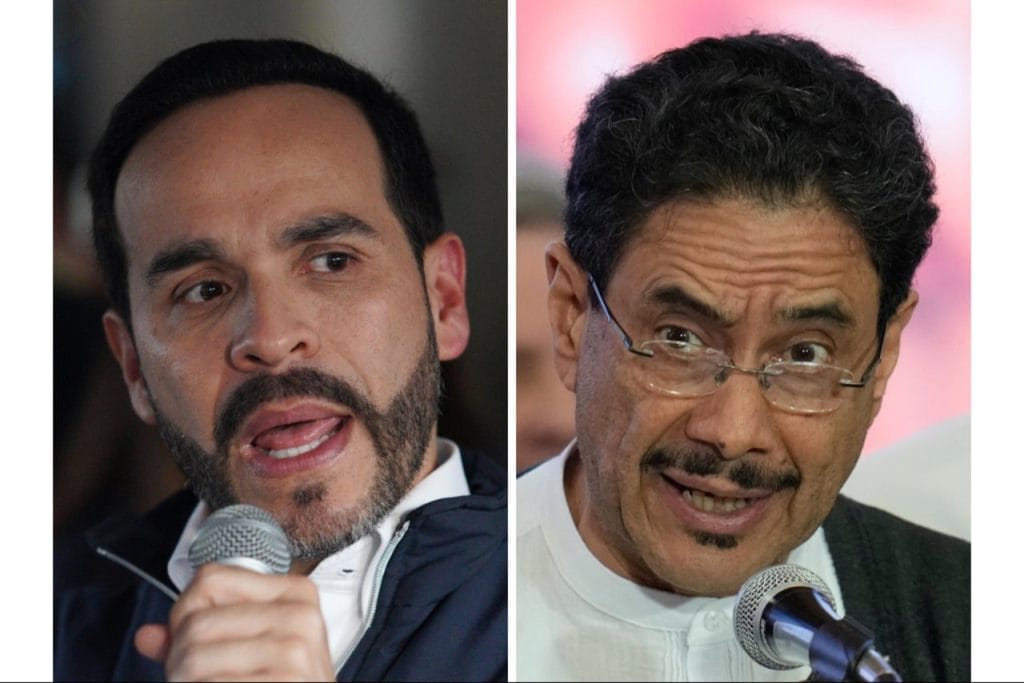
In this combination of photos shows presidential candidates Abelardo de la Espriella, left, on May 6, 2026, and Ivan Cepeda on May 31, 2026, in Bogota, Colombia.AP Photo
Cepeda is promising to continue Petro’s efforts, including attempts at establishing dialogue with multiple illegal armed groups even though those efforts have largely failed.
The two candidates also are offering differing solutions for the country’s struggling health system, ballooning public debt and entrenched corruption.
President again questions election results
In the first round, Cepeda earned 41% of the vote, while de la Espriella garnered 44%, according to official results. Petro, without evidence, sowed doubts in the results after Cepeda, who had consistently lead polls ahead of the May vote, did not win outright and even finished behind de la Espriella.
Petro reiterated his allegations on Sunday.
“We must protect the vote, undoubtedly,” he said shortly before polls opened.
His movement will provide details about “all the accounts and funds that were transacted from abroad,” Petro added. Actors, whom he did not
identify, “tried to enslave the people of Colombia by taking away their freedom to decide.”
Polls will remain open until 4 p.m. on Sunday.
Yolanda Hernández, 49, voted early, before she started selling black-ink pens outside a Bogota voting center. Clients, she said, buy the pens because ink cannot be erased from paper ballots, which reduces the possibility of fraud.
Hernández, who recycles trash for a living, voted for Petro in 2022, but cast her ballot for de la Espriella this time. While she acknowledged that Petro was unable to deliver on promises meant to help the poor because of
congressional gridlock, she said Colombia cannot afford another four years under his vision for the country.
“We want change in Colombia because it’s always the same violence, always the same thing,” Hernández said. “(Petro) said he was going to lower the cost of services, that he was going to lower the price of food, and everything is more expensive.”
Nation plagued by fighting between rebel groups
The election comes 10 years after Colombia signed a historic peace pact with guerrillas of the Revolutionary Armed Forces of Colombia, or FARC, that had offered hope to break the
nation’s vicious cycle of fighting between rebel groups and the government.
But violence has since roared back, particularly as most rebel groups abandoned their ideologically driven fight for the financial benefits of drug trafficking.