



Reiterating the REA’s commitment to facilitating a transparent investment pipeline, Dr. Aliyu called on the private sector to move from passive consumers to active solution structures.

Dr. Abba Aliyu, Managing Director of the Rural Electrification Agency
The Managing Director and Chief Executive Officer of the Rural Electrification Agency (REA), Dr. Abba Aliyu, has declared that distributed renewable energy represents Nigeria’s fastest path to sustained economic growth.
Delivering a keynote address titled “Scaling Mini-Grids and Solar Infrastructure for Industrial Production” at the Lagos Chamber of Commerce and Industry (LCCI) Renewable Energy Outlook Conference in Lagos Wednesday, Dr. Aliyu emphasised that Nigeria’s industrial competitiveness will hinge entirely on its ability to build reliable, affordable, and scalable electricity systems.
“Scaling mini-grids and solar infrastructure for industrial production is not about choosing between the grid and off-grid systems.”
“It is about designing a smarter power system that uses every viable tool available. Nigeria needs the national grid. Nigeria needs gas. Nigeria needs hydropower. Nigeria needs solar. Nigeria needs storage. Nigeria needs embedded generation. Nigeria needs mini-grids. Nigeria needs private capital. Nigeria needs local manufacturing. Nigeria needs data. And Nigeria needs coordination,” Dr. Aliyu stated.
The REA MD further noted that the renewable energy market of the future will look radically different from the power architecture of the past.
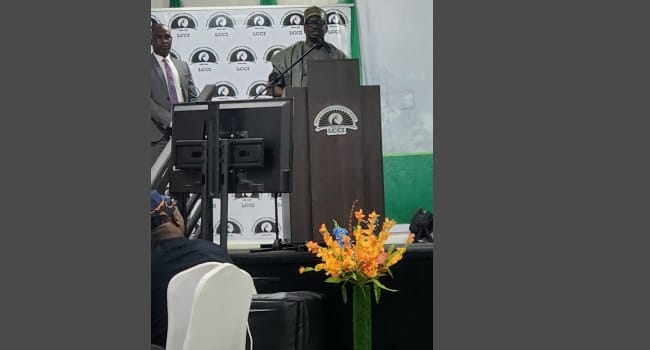
REA MD, Dr Aliyu, speaking at the LCCI event in Lagos on Wednesday, June 24, 2026
He emphasised that regulation must remain forward-looking, enabling commercial innovation while protecting consumers and preserving market discipline for the future.
He pointed to recent regulatory milestones by the Nigerian Electricity Regulatory Commission (NERC) as critical instruments moving the market from small pilot projects to industrial-scale deployment.
These include net billing frameworks and updated regulations that expand the capacity threshold for interconnected mini-grids from 1 megawatt (MW) up to 5MW. This expanded capacity creates room for factories, residential estates, market clusters, universities, and data centers to integrate seamlessly into a flexible power network.
Reiterating the REA’s commitment to facilitating a transparent investment pipeline, Dr. Aliyu called on the private sector to move from passive consumers to active solution structures.
“A mini-grid that powers homes changes lives. But a mini-grid that powers homes, a rice mill, a cold room, a welding cluster, a clinic, a digital services hub, and a market changes an economy,” Dr. Aliyu explained.
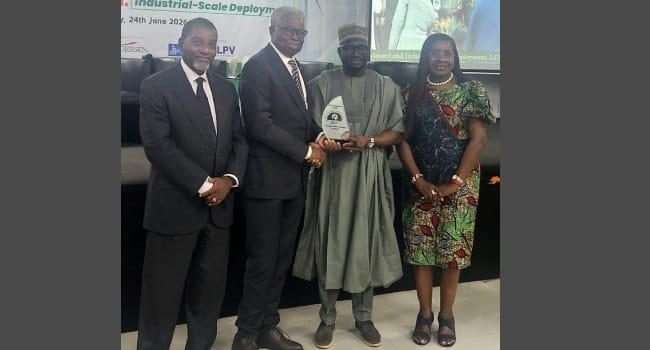
power. This administration has democratized energy governance,” he said.
He, however, maintained that the foundation being laid by the current administration is built to last.
Tegbe noted that while the government’s reforms are driven by a profound sense of urgency, structural overhauls of this magnitude require sustained momentum and legislative continuity rather than short-term fixes.
Also speaking, the President of LCCI, Engr. Leye Kupoluyi affirmed that energy costs have become a critical component of operational expenses for Nigerian businesses, severely limiting growth across all sectors.
Kupoluyi also commended the Minister and the Rural Electrification Agency (REA) for their innovative, off-grid renewable solutions that are delivering accessible electricity to underserved populations, while stressing that achieving a successful transition requires massive, industrial-scale private sector investments to ensure darkness becomes a thing of the past.