



When the storm first hit early Monday, the NWS urged Rota’s roughly 1,500 residents on X to “treat these imminent extreme winds as if a tornado was approaching and move immediately to an interior room or shelter NOW!”
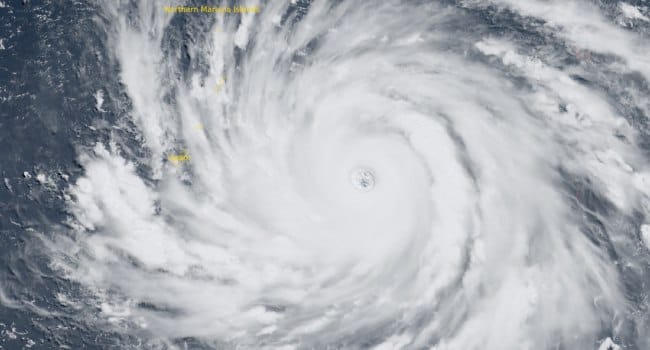
This satellite image handout from the Cooperative Institute for Research in the Atmosphere (CIRA) in partnership with the Regional and Mesoscale Meteorology Branch (RAMMB/NOAA) and the Colorado State University (CSU) taken on July 5, 2026 at 01:20 UTC shows the super typhoon Bavi as it develops and nears Guam and the Northern Mariana islands in the western Pacific Ocean. (Photo by Handout / various sources / AFP)
A “super typhoon” with the force of a category-five hurricane tore through the US Pacific territories of Northern Marianas and Guam on Monday, with authorities saying they had received reports of “major” damage on the small island of Rota.
The National Weather Service (NWS) said that the “entirety” of Rota was in the eye of Super Typhoon Bavi, with winds of up to 180 miles (290 kilometers) per hour before moving “ever so slowly away” westwards.
But the group of islands – several thousand kilometres (miles) west of the mainland United States – was by midday still being buffeted by fierce winds and driving rain that left residents holed up indoors.
When the storm first hit early Monday, the NWS urged Rota’s roughly 1,500 residents on X to “treat these imminent extreme winds as if a tornado was approaching and move immediately to an interior room or shelter NOW!”
Local authorities on Rota -– the southernmost part of the Northern Marianas, less than 80 km (50 miles) north of Guam — said they had received reports of “major damages”, but with communications difficult, the extent was unclear.
“We are hanging in there. We are experiencing heavy winds and flooding here… Some people are already reporting major damages,” the Rota Municipal Operations Center’s public information officer, Lou Rosario, said.
Rosario added that some cellphone services were down because of a fallen tower.
Previously, the NWS had warned that a direct hit on Rota would make most of the island “uninhabitable for weeks, perhaps longer” with nearly all trees snapped and power outages for “weeks to possibly months”.
The island of Tinian, northern parts of Guam, and the southern tip of Saipan experienced winds equivalent to a category-one hurricane, NWS meteorologist Marcus Landon Aydlett told a briefing on Facebook Live.
“Super Typhoon Bavi is leaving the area,” he said. “Gradually, conditions are going to be improving.”
The Northern Marianas and the nearby separate US territory of Guam are collectively home to around 210,000 people.
Authorities on Guam had said the island could see eight to 12 inches (20 to 30 centimeters) of precipitation, resulting in potential flash flooding.
The NWS said that winds of 50-80 mph and gusts of 100 mph were expected to last through late afternoon.
to seven years and lasts nine to 12 months, has already begun in the tropical Pacific and is likely to be strong.
The natural climate phenomenon warms surface temperatures in the central and eastern equatorial Pacific Ocean, bringing worldwide changes in winds, pressure, and rainfall patterns.
“Our big concern for this being an El Niño year is that it’s going to be a lot busier than we’ve seen in the last five or six years,” said Aydlett of the NWS.