



From lowering operational costs for food vendors and phone chargers to illuminating stalls and curbing local crime, this circular economy blueprint demonstrates how urban waste can be successfully repurposed to power small businesses and combat climate change.
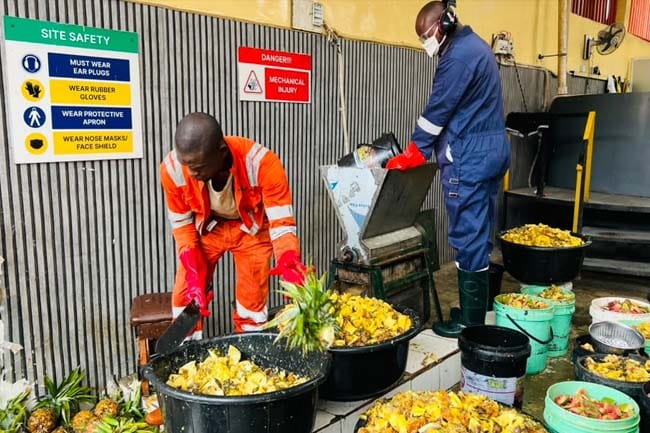
Inside a facility with a “SITE SAFETY” sign mounted on a corrugated wall, two plant workers are actively sorting and processing discarded organic matter.
For over two decades, pineapple trader Adebisi Olaitan has watched the market evolve. Her fruits are transported from Benin, and by the time they arrive in Lagos, some have already begun to spoil.
“Most of the time, the pineapple I sell comes from Benin and before it gets here it’s already morning, and sometimes some get spoiled,” Olaitan said.
By late afternoon, the familiar scent of ripe pineapples and watermelons hangs over Ikosi Fruit Market in Ketu.
Traders negotiate with customers while wheelbarrows piled high with bruised fruits weave through narrow paths. For years, whatever could not be sold ended up in waste heaps, attracting flies, producing foul odours and eventually finding its way to landfill.
Today, those same fruits are powering the market.
Behind the bustling market, spoiled fruits once treated as waste are now turned into renewable energy and organic fertiliser. At the heart of this transformation is the Ikosi Fruit Market Biodigester Plant, a Lagos State Government project developed with C40 Cities and supported by UK International Development.
Here, spoiled fruits are collected, washed, shredded and processed in sealed digesters, where microorganisms break them down without oxygen to produce biogas.
From Fear Into Light
For many traders, the project has become more than an environmental initiative; it has changed the rhythm of doing business.
The lighting, Olaitan said, has also improved security. She remembers when darkness descended each evening, forcing traders to pack up early while customers hurried away.
“There have been changes. If it gets towards evening, they turn on the lights for us to see what we are selling.
The savings have also reached small business owners. Hameed Orilomo, who operates a POS and phone charging business, said he previously relied on petrol generators, spending between ₦15,000 and ₦20,000 daily.
“Since they introduced renewable energy, it has benefited me well. My charging prices were higher when I used fuel, but now I have reduced them because of the gas,” he said.
In between the facility and the fruit market, food vendor Mariam Morof, popularly known as Bebe Olounje, said the cleaner fuel has reduced her operating costs.
“Since they brought the gas here, it has reduced the amount we spend on gas, and it works much better. It doesn’t produce smoke when you cook, and it keeps the pots clean,” she said.
A Blueprint
For the Lagos State Government, the project is about more than providing cheaper energy.
Chief Scientific Officer at the Lagos State Office of Environmental Services, Christopher Orororo, said the initiative addresses one of the city’s biggest environmental concerns by preventing organic waste from ending up in landfills.
“The whole essence of the programme is to tackle the threat of climate change. The waste being generated is no longer going to the dump sites. It is being turned into something beneficial for the market people. It’s more of what you call a circular economy,” he said.
The CSO said the facility generates between 24 and 28 kilowatt-hours of electricity daily, depending on sunlight, while methane from the biodigester powers market lighting, food vendors and phone charging businesses. Even the leftover digestate is converted into bio-fertiliser for farmers.
“Before now, traders paid for this waste to be evacuated. Now we collect it free. Nothing is wasted,” Orororo added.
The project arrives as Lagos grapples with a mounting waste challenge. The state generates between 13,000 and 20,000 metric tonnes of waste every day, with organic waste accounting for a significant share.
Much of it eventually decomposes in landfills, releasing methane, one of the most potent greenhouse gases driving climate change.
At Ikosi Fruit Market, however, spoiled fruit is no longer simply refuse awaiting disposal. Instead, it is fuelling cookstoves, lighting up market stalls, powering small businesses, and returning to farms as fertiliser.