


The US military said its five-hour mission hit targets across Iran including coastal Bushehr and Bandar Abbas to “degrade Iran’s ability to attack commercial shipping”.
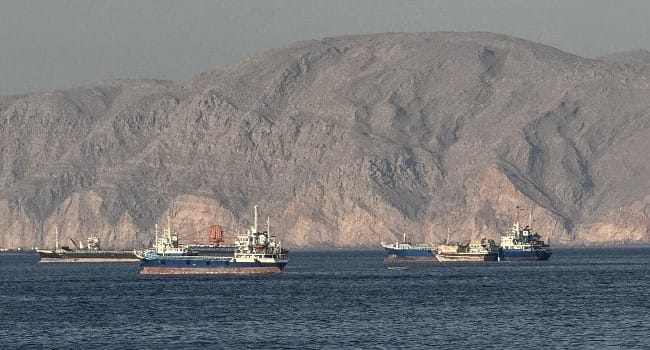
FILES) Vessels are seen anchored in the Strait of Hormuz, off the port city of Khasab on Oman’s northern Musandam Peninsula on May 17, 2026. Tehran announced it was closing the Strait of Hormuz on July 12 and launched missiles and drones at its Gulf neighbours, in retaliation for new US strikes following an attack by Iranian forces on a merchant vessel that was abandoned in flames by its crew. (Photo by AFP) /
The United States launched a third night of strikes on Iran as President Donald Trump planned to reimpose a blockade Tuesday on Iranian ports and floated a 20 percent fee on cargo in the vital Strait of Hormuz.
Trump said a deal with the Islamic republic was still possible even as attacks were carried out, with Iran striking two ships in the strategic waterway and killing one crew member, according to the United Arab Emirates.
The US military said its five-hour mission hit targets across Iran including coastal Bushehr and Bandar Abbas to “degrade Iran’s ability to attack commercial shipping”.
After the strikes, Iran’s Revolutionary Guards announced they had in turn fired missiles and drones on Bahrain, targeting a residential building for US forces and other facilities.
“We’re going to hit them very hard tonight, and we’re going to hit them hard tomorrow,” Trump said at the White House on Monday.
Trump’s declaration on the Hormuz blockade followed US and Iranian attacks of a scale unseen since an April ceasefire in the Middle East conflict, adding to doubts about efforts to bring a permanent end to the war.
READ ALSO: Oil Extends Gains After Latest US Strikes, Tech Suffers More Losses
Iran started blocking the strait after US-Israel attacks in February, which prompted Washington’s blockade on Tehran’s ports — but restrictions eased after the sides agreed a preliminary deal in June.
Trump said Monday that the United States was “taking over” the strait and would slap a levy of 20 percent on all cargo shipped through it, in an announcement that drew mockery from Iran and accusations of “piracy”.
US Central Command (CENTCOM) said Iran’s ports on the waterway would be blockaded from 2000 GMT on Tuesday.
Oil prices shot up more than nine percent Monday over fears of renewed conflict and rose again Tuesday, piling on more than one percent.
Tehran launched attacks on other US allies in the region, including Jordan, which said it had shot down four missiles from Iran.
Iran’s Revolutionary Guards said their strikes targeted US forces at an air base and urged Jordanians to issue a “serious demand for the removal of the occupying American bases from the region”.
Baqaei said Iran would ignore its obligations under the deal if the Washington did the same, but added that Tehran was continuing talks with mediators from Qatar, Pakistan and Oman to prevent further escalation.
Bader Al-Saif, an associate fellow at Chatham House, said the escalating attacks would merely delay a permanent agreement.
“Both sides want to end the impasse on their own terms, and they are increasingly finding it difficult to do so,” he said.
“Hence the return to and increase in the scale of attacks.”