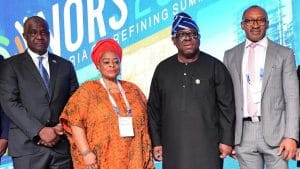




File phot: Permanent Secretary of the Federal Ministry of Communications, Innovation and Digital Economy, Nadungu Gagare.
The Federal Government has called for stronger regional cooperation among African countries to bridge the continent’s digital divide, saying greater collaboration is needed to expand connectivity, strengthen cybersecurity, harmonise digital policies and build an inclusive digital economy.
The Permanent Secretary of the Federal Ministry of Communications, Innovation and Digital Economy, Nadungu Gagare, made the call on Thursday at the Special Session of the Administrative Council of the African Telecommunications Union in Abuja.
Gagare, who was represented by the ministry’s Director of Human Resource Management, Ahmed Alsukun, said African countries must work together to tackle shared digital challenges ahead of key continental and global telecommunications meetings.
He said, “We believe that regional cooperation is essential if Africa is to build a strong, inclusive, and innovative digital economy. Working together, we can expand connectivity, improve digital infrastructure, promote digital skills, strengthen cybersecurity, protect data and create opportunities for our people, especially our youth.”
The permanent secretary said the special session was taking place at a critical period as African countries prepared for the forthcoming ATU Conference of Plenipotentiaries.
He noted that the decisions reached in Abuja would help shape the future of the union and strengthen Africa’s common position on telecommunications and digital policy issues.
“The decisions and the discussions over the next two days will inform the future of our union and strengthen Africa’s common position on key telecommunication and digital policy issues,” he said.
The permanent secretary said the special session was taking place at a critical period as African countries prepared for the forthcoming ATU Conference of Plenipotentiaries.
He noted that the decisions reached in Abuja would help shape the future of the union and strengthen Africa’s common position on telecommunications and digital policy issues.
“The decisions and the discussions over the next two days will inform the future of our union and strengthen Africa’s common position on key telecommunication and digital policy issues,” he said.
According to him, the council’s consideration of reports, proposed amendments to the union’s foundational instruments, work programmes and conference agenda would provide the institutional framework for the Conference Preparatory Committee and the Seventh Ordinary Session of the Conference of Plenipotentiaries.
Gagare noted that although Africa had recorded significant progress in information and communications technology through expanding mobile connectivity and digital innovation, substantial challenges remained.
He said, “Africa has made significant progress in the ICT sector over the years. Mobile connectivity has grown. Digital innovation is expanding rapidly, and governments are increasingly adopting digital technologies to improve public service delivery. However, many challenges remain. Millions of our citizens still lack reliable internet access. Digital infrastructure is unevenly distributed, and emerging technologies such as artificial intelligence require coordinated policy and sustained capacity building.”
He further cited recent data showing that almost one billion Africans still do not use mobile internet despite living within broadband coverage.
“Almost one billion people in Africa do not use mobile internet despite living within broadband coverage. Infrastructure expansion must therefore be matched by affordability, suitable devices, digital skills, trust and local services,” he said.
Describing the challenge as an opportunity for deeper collaboration, Gagare said member states should leverage the African Telecommunications Union to develop common solutions.
“Working together through the ATU, we can develop common solutions, share experience, attract investment and make certain that no African country is left behind in digital development,” he added.
He reaffirmed Nigeria’s commitment to the African Telecommunications Union, saying the country would continue to support initiatives that promote digital inclusion, innovation, spectrum management, cybersecurity, digital infrastructure and policy harmonisation across the continent.
The permanent secretary also said preparations for the 2026 International Telecommunication Union Plenipotentiary Conference in Doha presented an opportunity for African countries to strengthen continental unity and present a common front on global digital issues.
“As we prepare for the International Telecommunication Union Plenipotentiary Conference 2026 in Doha, this meeting provides an opportunity for Africa to strengthen its unity and speak with one voice on issues that affect the future of global telecommunication and digital development,” he said.
He added, “The common position advanced through the ATU process must reflect Africa’s priorities with clarity and be supported consistently by our delegation. A united Africa will have greater influence in international decision-making and will be better placed to advance and protect the interests of our continent.”
Earlier, the Secretary-General of the African Telecommunications Union, John Omo, described the meeting as a crucial statutory step towards the Seventh Ordinary Session of the Conference of Plenipotentiaries.
He said the council would review the union’s activities for the 2023 to 2026 period, proposed constitutional amendments and preparatory documents to ensure that decisions presented to the conference were legally sound, credible and fully supported.
Also speaking, the Chairperson of the ATU Administrative Council and Director-General of South Africa’s Department of Communications and Digital Technologies, Nonkqubela Jordan-Dyani, urged African countries to strengthen regional cooperation to improve economic resilience amid geopolitical tensions, climate challenges and rapid technological change.
She said Africa should prioritise affordable connectivity, digital public infrastructure, digital skills and enabling policies for emerging technologies such as artificial intelligence, while deepening partnerships with governments, development institutions, the private sector and academia to accelerate the continent’s digital transformation.