



Follow the latest news on President Donald Trump and his administration | July 27, 2026
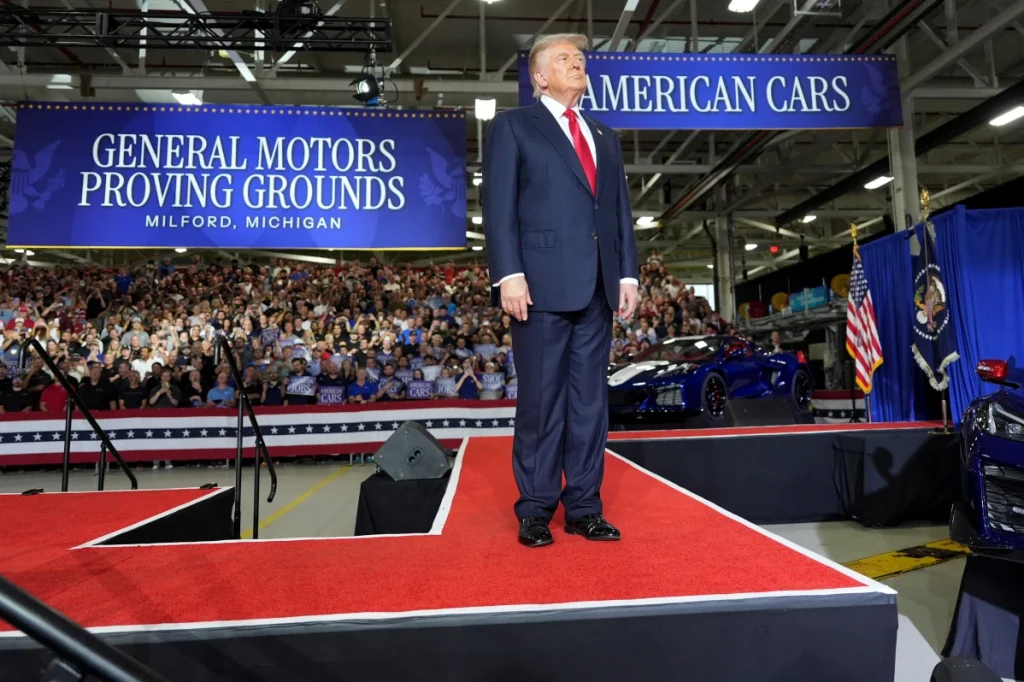
President Donald Trump arrives to speak at General Motors proving ground, Monday, July 27, 2026, in Milford, Mich. (AP Photo/Alex Brandon)
Here’s what we’re following:
- A federal appeals court has upheld a ruling that halted President Donald Trump’s executive order to create a federal list of eligible voters and limit delivery of mail ballots only to people on that list. The ruling over the weekend rejected the Trump administration’s effort to move forward with the mail-in voting restrictions in 23 U.S. states that sued ahead of November’s midterm elections.
- President Trump is touting his handling of the economy during a visit to suburban Detroit on Monday, defending sweeping tariffs in a swing state where their effects have hurt many businesses as midterm election season heats up.
- The United States and Iran paused their attacks for a second straight day Sunday, as efforts continued to bring them back to negotiations on an interim ceasefire deal. It was not clear why the U.S. has paused after targeting Iranian coastal areas and infrastructure in a nearly two-week escalation sparked by Iran’s firing at ships trying to transit the Strait of Hormuz
Trump talks up tariffs as he claims to have saved the American auto industry
Speaking to workers at a GM facility in Milford, Michigan, Trump touted steep tariffs that he says have protected the U.S. auto industry and revived production in the United States.
He pointed to a 25% tariff his administration placed on foreign cars, “something that no other president had the courage to ever do.”
Speaking on stage alongside a blue muscle car, Trump told workers that the industry was in peril until he took office and removed regulations passed by Democrats.
“I’ve done more for you than your parents. OK?” Trump said. “Your parents are good. I’m not going to knock your parents. But I have been better to you than your parents.”
WASHINGTON (AP) — The Trump administration asked the Supreme Court on Monday to clear the way for an executive order from President Donald Trump that could dramatically change mail-in voting ahead of November’s midterm elections.
The Justice Department asked the justices to halt for now lower court decisions blocking the sweeping changes in nearly half the country.
The request comes shortly after Trump delivered a primetime address elevating his yearslong push to raise doubts about the legitimacy of elections, and could be one of several voting-related challenges before the court ahead of the high-stakes midterm contest.
Trump ordered the government in March to create a “state citizenship list” of eligible voters and deliver mail ballots only to people on that list.
Democratic officials in 23 states and the District of Columbia sued, saying the Constitution gives states and Congress the authority to set election rules, not the president. Their attorneys have said Trump’s proposed changes are ripe for abuse and could cause chaos.
A judge in Massachusetts blocked the executive order for the plaintiff states, and a divided 1st U.S. Circuit Court of Appeals panel left her ruling in place over the weekend.
The executive order calls for U.S. Citizenship and Immigration Services and the commissioner of the Social Security Administration to send state officials federal citizenship lists to determine eligible voters. It tells the U.S. Postal Service to deliver mail ballots only to people on the lists.
The order also calls for ballots to have secure envelopes with unique barcodes for tracking. Federal funding could be withheld from states and localities that don’t comply.
The appeal argues that Trump’s order lays out “general policy guidance” and doesn’t directly dictate how states run their elections. Solicitor General D. John Sauer asked the high court to freeze the judge’s order as lawsuits play out, calling it indefensible.
“And the injunction is especially indefensible because the agencies are still deliberating over how (if at all) to implement the Order, yet the district court preemptively decided that whatever the agencies may choose to do will necessarily be unlawful,” Sauer wrote.
He urged the high court to move quickly, arguing that any new policies would have to be in place as soon as August to be effective for the November elections.
A response to the appeal is due Aug. 3.
The Supreme Court has ruled against the Trump administration before on mail-in ballots, finding in June that states can count ballots that arrive after Election Day.
Trump has promoted the proposed changes in his executive order as safeguards to keep non-U.S. citizens from voting. He’s also repeatedly pressed for the passage of legislation that requires proof of citizenship to vote.
Noncitizen voting has been shown to be rare, and is a felony that can be punishable by deportation.
U.S. District Court Judge Indira Talwani in Boston, who was nominated by Democratic President Barack Obama, agreed in June to halt implementation for the Nov. 3 elections.
Her ruling differed from that of another federal judge based in Washington. U.S. District Judge Carl Nichols, who was appointed by Trump, found in May it was too early to block the order because it had not yet been implemented.
He urged the high court to move quickly, arguing that any new policies would have to be in place as soon as August to be effective for the November elections.
A response to the appeal is due Aug. 3.
The Supreme Court has ruled against the Trump administration before on mail-in ballots, finding in June that states can count ballots that arrive after Election Day.
Trump has promoted the proposed changes in his executive order as safeguards to keep non-U.S. citizens from voting. He’s also repeatedly pressed for the passage of legislation that requires proof of citizenship to vote.
Noncitizen voting has been shown to be rare, and is a felony that can be punishable by deportation.
U.S. District Court Judge Indira Talwani in Boston, who was nominated by Democratic President Barack Obama, agreed in June to halt implementation for the Nov. 3 elections.
Her ruling differed from that of another federal judge based in Washington. U.S. District Judge Carl Nichols, who was appointed by Trump, found in May it was too early to block the order because it had not yet been implemented.
The order also calls for ballots to have secure envelopes with unique barcodes for tracking. Federal funding could be withheld from states and localities that don’t comply.
The appeal argues that Trump’s order lays out “general policy guidance” and doesn’t directly dictate how states run their elections. Solicitor General D. John Sauer asked the high court to freeze the judge’s order as lawsuits play out, calling it indefensible.
“And the injunction is especially indefensible because the agencies are still deliberating over how (if at all) to implement the Order, yet the district court preemptively decided that whatever the agencies may choose to do will necessarily be unlawful,” Sauer wrote.