



Elite creators like Dhar Mann ($65M) and iShowSpeed ($30M) are capturing unprecedented media revenue with fractional overhead.
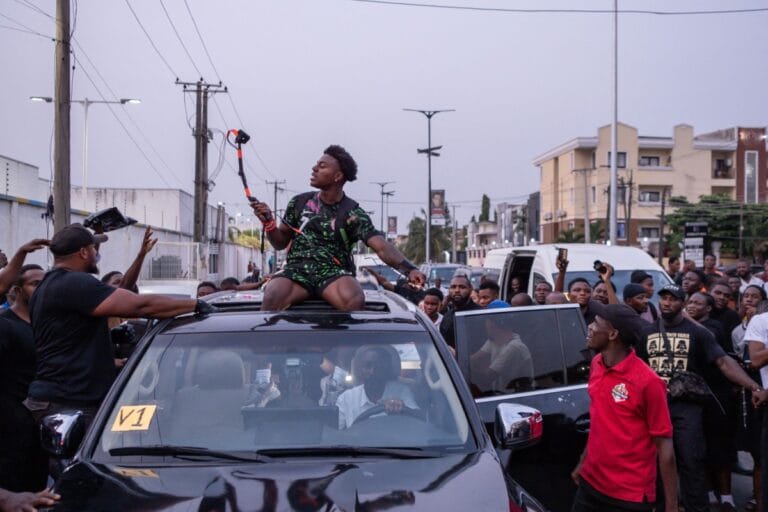
The influencer famous on YouTube and Twitch kicked off an African tour on December 29 that took him to around fifteen countries, from the south to the north of the continent, drawing crowds of admirers at every stop. (Photo by TOYIN ADEDOKUN / AFP)
The digital media landscape has officially reached a billion-dollar tipping point, but the true story lies in the structural mechanics of how that money is made.
When Forbes dropped its 2026 Top Creators list, the headline figure crossed a historic milestone: the top 50 creators collectively generated $1.02 billion between March 2025 and March 2026—a 20% surge from the figure reported last year. Led by Jimmy Donaldson’s (@mrbeast) unprecedented $300 million haul, the top 10 alone accounted for $621 million.
Evaluating these figures requires shifting the lens from gross revenue to structural profitability. Forbes tracks gross income before production costs, and the operational divide between digital empires and legacy television remains stark.
The Profit Margin Divide: Content vs. Conglomerates
Traditional media networks operate as capital-heavy, high-overhead institutions. Even when wildly successful, linear networks and legacy studios face immense structural friction via legacy union contracts, physical studio lots, executive syndication costs, and massive distribution fees. In contrast, top digital creators utilise a highly decoupled, lean production model.
The baseline operational metrics of 2026 demonstrate why capital is migrating from legacy broadcasting toward solo-driven entities:
| Metric | Traditional TV Networks (2026) | Elite Creators / Digital Studios (2026) |
| Average Operating Margins | 15% – 25% | 40% – 70% |
| Distribution Infrastructure | High cost (Cable/Satellite/Broadcasting) | Zero marginal cost (YouTube, TikTok, Spotify) |
| Primary Monetization | Ad-spot sales & Carriage fees | Direct IP ownership, B2B services, Brand equity |
While outliers like MrBeast aggressively reinvest nearly 100% of their gross revenue back into massive $3 million to $5 million video production budgets, the rest of the list represents a masterclass in hyper-efficiency:
- The High-Ticket Niche Model: @codiesanchez ($31 million) sneaked into the top ten with the list’s smallest audience. By translating financial advisory content into high-margin B2B digital products and business ecosystems, her operating costs remain low, yielding profit margins that traditional print or digital business publications cannot match.
- The Lean Broadcast Factory: British-Nigerian creator @steven (Steven Bartlett) hit $52 million to take the number three spot, while @rhettandlink pulled in $37 million. Their interview- and studio-based formats require fractional overhead relative to their revenue, allowing them to extract maximum profit per dollar earned.
Shifting Geographies and Institutional Scale
This billion-dollar milestone is no longer strictly dominated by North American content models. The ecosystem is rapidly globalising, with immense value flowing toward African-linked talent. Frontline creators are increasingly using regional tours to capture hyper-engaged global eyeballs, while diaspora and local talent industrialise their actual businesses:
- Streaming sensation @ishowspeed generated $30 million by treating geographical expansion as a core business strategy, notably live-streaming across 20 African countries in just 28 days to unlock entirely new, highly active audience pools.
- Senegal-born creator Khaby Lame secured the number 15 spot on the global list, turning silent comedy parodies into $9.9 million in annual creator earnings. Highlighting the transition of individual talent into investable corporate equity, Lame’s brand and commercial rights became the centrepiece of an all-stock corporate transaction with Hong Kong-based Rich Sparkle Holdings. While the corporate vehicle was hit by public-market volatility and regulatory trading restrictions later in the year, the initial structural valuation of up to $975 million—leveraging Lame’s “Face ID” and “Voice ID” to build an AI digital twin for automated live-stream e-commerce—underscores how legacy financial markets now view digital attention as an institutional asset class.
- This international commercial push is further mirrored by multi-platform cultural leaders like Nigerian-American creator Drea Okeke, who has successfully converted viral storytelling formats into highly commercial enterprise partnerships.
Flashback: Traditional Media 10 Years Ago (2016)
This globalised, ownership-led scale stands in stark contrast to what the traditional media landscape earned exactly a decade ago. In 2016, traditional television networks were at peak monetisation before cord-cutting accelerated:
Lexi Rivera: Family-friendly situational skits, stunts, and physical challenges.
Marques Brownlee (MKBHD): High-end technological review, architecture, and digital product evaluation.
Mikayla Nogueira: High-ticket cosmetics reviews and digital brand activation campaigns.
MrBallen (John Allen): Audio storytelling specialised in historical and investigative crime.
Ms. Rachel (Rachel Griffin Accurso): Early-childhood cognitive development and foundational educational programming.
Nick DiGiovanni: Elite gastronomy, culinary masterclasses, and global food challenges.
Nara Smith: Traditional, specialised homemade culinary craftsmanship diaries.
Rebecca Zamolo: Narrative adventure arcs and family-friendly scripted series.
Stokes Twins: High-overhead, large-scale public stunts and community challenges.
Tini Younger (Tineke Younger): Culinary instruction and rapid-growth digital cookbook distribution.
Typical Gamer (Andre Rebelo): High-frequency streaming and independent virtual interactive maps.
Vivian Tu (Your Rich BFF): FinTech integration and AI-assisted retail monetary advice.