


New trial set to take place in October after jury fails to reach decision in closely-watched case on Palisades Fire.
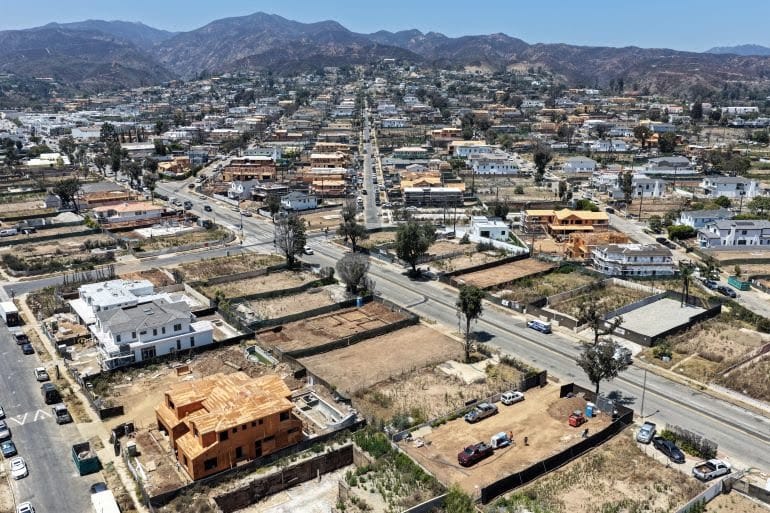
An aerial view of construction workers rebuilding houses which were destroyed in the Palisades Fire on June 25, 2026 in Pacific Palisades, California
A United States federal judge has declared a mistrial in an arson case brought against a man suspected of sparking the flames that would later grow into one of the deadliest wildfires in California history.
Judge Anne Hwang declared a mistrial on Friday morning, one day after local media reported that the jury in the case had informed her that they were not able to reach a unanimous decision.
Out of 12 jurors, 10 believed that the suspect, Jonathan Rinderknecht, was innocent. Federal prosecutors promised to retry the man they accused of intentionally setting the fire.
“The evidence is strong that Jonathan Rinderknecht is responsible for igniting the fire on January 1, 2025, which eventually became the Palisades fire. We fully intend to retry this case before a new jury and obtain guilty verdicts on all charged counts,” US attorney for the Central District of California, Bill Essayli, said in a social media post in response to the decision.
Judge Hwang ordered Rinderknecht detained until his retrial begins on October 19.
Culpability for the Palisades Fire, which led to the deaths of 12 people and destroyed entire neighbourhoods along the coast north of Los Angeles, has become a contentious issue.
Prosecutors allege that Rinderknecht used a barbecue lighter to light a fire on January 1, 2025. Firefighters initially believed that they had successfully suppressed the flames, only for them to spark a blaze on January 7 after continuing to burn undetected in the root system.
Fierce winds then swept the flames across the area’s dry landscape, fuelling the fire that eventually spread into populated areas and caused widespread destruction.
Conditions such as drought, worsened by climate change, and an increase in the number of people living in fire-prone areas at the edge of wildlands, have contributed to the increased lethality of wildfires in the Western US.
A juror who identified themselves as Syrena but declined to share her last name told the news service The Associated Press that it seemed unfair to assign Rinderknecht blame for the fires, given the negligence of other parties.
“There just isn’t enough proof,” she said.
“Shouldn’t the firemen, shouldn’t they have known?” she added.
The government did not offer direct proof that Rinderknecht lit the initial blaze, arguing that he had been in the area where it took place and portraying him as an aggrieved individual who sought to take out his anger on society through arson.
“This is a big victory, and it feels so unfair that, given the circumstances, the government maintains my son in jail,” said the suspect’s father, Joel Rinderknecht.