


Experts say the first 72 hours after natural disasters define the narrow window for rescuing the living. After that, the search usually becomes one of recovering bodies.
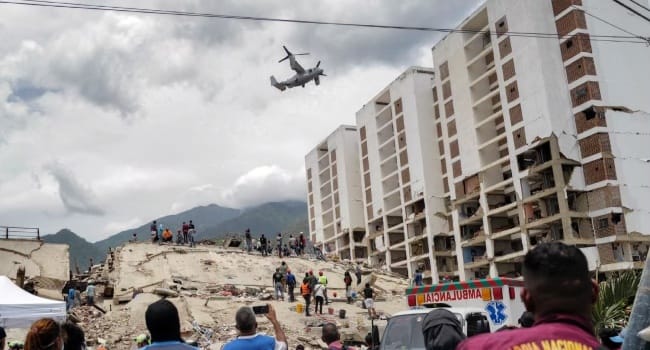
An Osprey aircraft overflies a quake-hit area in Caraballeda, La Guaira State, Venezuela on June 28, 2026, following twin earthquakes. Photo by MAURICIO VALENZUELA / AFP
Hopes were fading Monday of finding survivors more than four days after powerful twin earthquakes struck Venezuela, as residents grow increasingly frustrated with the government’s response to the disaster that has killed at least 1,450 people and left tens of thousands unaccounted for.
A strong aftershock was felt in the hardest-hit areas of the capital Caracas and La Guaira shortly after 7:00 am (1100 GMT) on Monday, which the US Geological Survey measured at magnitude 4.6, adding to fears for the safety of hundreds of buildings weakened by the tremors.
French and American rescue teams found a man and his teen son alive under the rubble on Sunday in Caraballeda, a town about 40 kilometers (25 miles) north of Caracas, AFP journalists saw.
Screengrabs taken from a video posted on Instagram on June 26, 2026, show a newborn baby being pulled out alive from the rubble of the city of La Guaira, Venezuela, and cared for after twin earthquakes hit the country. Photo by -UGC / UGC / ANDREINA QUINTERO / AFP
The rescue offered a glimmer of hope in an ongoing tragedy that has shaken a country already mired in an economic crisis, but that hope dwindled as the critical 72-hour window for rescuing trapped victims passed.
Millions more people were feared to lack sanitation and other basic needs after one of Latin America’s most devastating earthquake disasters.
Some 774 buildings were badly damaged in back-to-back quakes of magnitude 7.2 and 7.5 that struck on Wednesday evening, including 189 buildings that have totally collapsed, National Assembly President Jorge Rodriguez said on Sunday.
AFPTV drone footage from La Guaira showed smoke rising from piles of concrete and debris, where a neighborhood of multistorey buildings once stood.
In the coastal town of Tucacas, rescuers were digging for people trapped in the pancaked layers and rubble of a collapsed building complex.
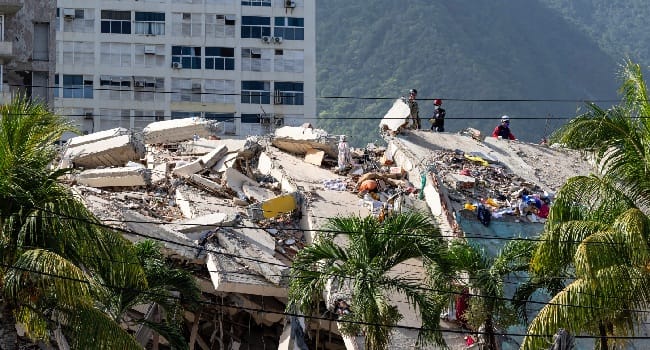
A collapsed building is seen from the base camp of the French Civil Security Training and Intervention Regiment (UIISC 7) at the Karting La Guaira complex in Caraballeda, La Guaira state, Venezuela, on June 27, 2026, as they assist with rescue operations following earthquakes. Photo by MIGUEL MEDINA / POOL / AFP
Luis Salas, 27, who joined the rescue efforts, told AFP that “the hardest part was when we felt hope in the tunnels we went into — crawling, clearing debris, working with all our heart, with great faith — and when we reached our targets, we found them lifeless.”
Experts say the first 72 hours after natural disasters define the narrow window for rescuing the living. After that, the search usually becomes one of recovering bodies.
In the Caracas neighborhood of Chacao, Caracas, large electronic screens on a building usually used for advertising were showing the faces of missing people.
Last week, UN aid chief Tom Fletcher said that more than 50,000 people were missing.
On Sunday, Rodriguez said the death toll — which was still expected to rise — had treached 1,450 people, with at least 3,150 others injured.
‘Can’t do it alone’
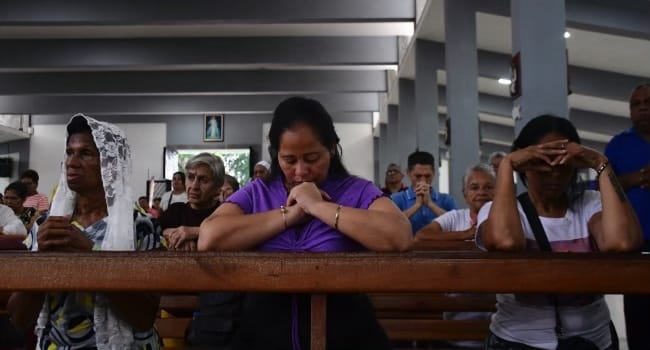
Locals pray during a mass within the National Day of Prayer for the quake victims in Valencia, Carabobo state, Venezuela, following twin earthquakes, on June 28, 2026. Photo by JACINTO OLIVEROS / AFP
Even as rescue efforts continued, public anger has mounted in some areas.
Eduardo Cardozo, a volunteer in Tucacas, said it was “frustrating” to know that some victims could have been saved “if they’d been searched for in time.”
In La Guaira state’s Tanaguarena area, one man urged soldiers to pick up picks and shovels: “The country needs you. Put down your weapon.”
Outbreaks of looting have hit La Guaira city, much of which now lies in rubble.
Pharmacies, supermarkets and other businesses were ransacked, said residents, some of whom complained of the slow and meager post-quake aid coming from authorities.
Venezuela’s interim president, Delcy Rodriguez, said on Sunday that temporary camps were being set up for people who had lost their homes.
“At the same time, work begins on planning projects that will allow new homes to be built in a very short time,” she said.
Economic impact
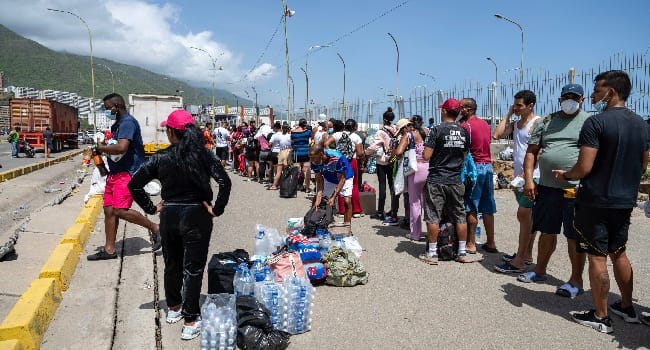
People queue to receive food and water donations in Caraballeda, La Guaira state, Venezuela, on June 27, 2026, following earthquakes. Photo by MIGUEL MEDINA / POOL / AFP
Rodriguez praised rescuers on Sunday, saying “we have rescued people who are still alive, and therefore these efforts will not be suspended.”
“We always hold onto hope.”
Cardozo, the Tucacas volunteer, remained hopeful: “We’re still here waiting. Let’s see if we can get someone else out.”
Twenty-four nations have sent 521 tons of supplies, 86 units with dogs trained to locate people trapped beneath the rubble and more than 2,700 search-and-rescue personnel, according to Rodriguez.
US helicopters ferried in aid, and 230 more US military personnel were arriving to help expand airport capacity and reopen a key seaport to boost relief efforts, the US Southern Command said.
The United States — which captured Venezuela’s former president Nicolas Maduro in a military raid on Caracas in January — had already sent a 250-strong disaster response team.
The UN migration agency said that based on population and damage data, up to 6.76 million people could be affected, and would require shelter, water, sanitation, healthcare and essential relief items.
Venezuela’s worst earthquakes in more than a century have come after the oil-rich country endured more than a decade of economic collapse.
The crisis has hollowed out hospitals and public services, driving millions to leave the country.
The United Nations estimated $6.7 billion in physical damage — equivalent to six percent of Venezuela’s GDP.