



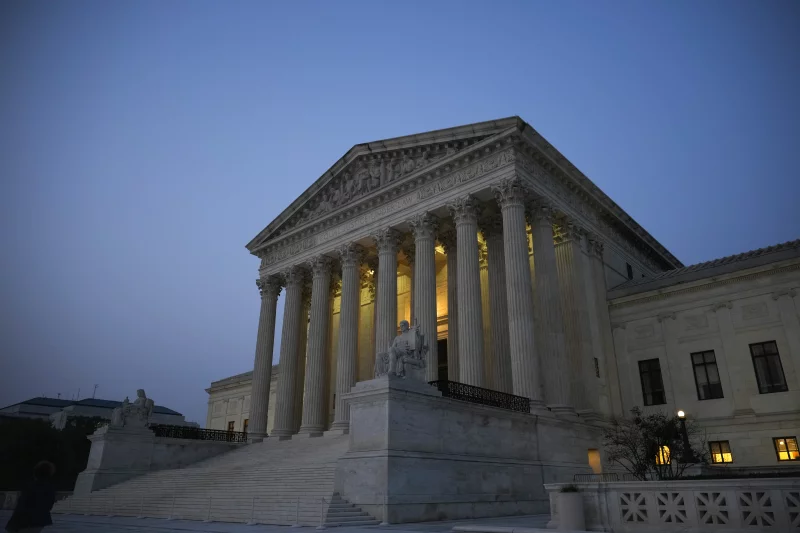
The U.S. Supreme Court
Drew Angerer/Getty Images
In a sharp rebuke to President Trump, the Supreme Court ruled Tuesday that the Constitution guarantees automatic birthright citizenship to virtually all children born in the United States.
Chief Justice John Roberts wrote the court’s 6-3 opinion, citing both the colonists’ demands for the “rights of Englishmen” as well as the abolitionists lauding of the “ancient and universal” rule of citizenship by birth alone.
“Citizenship, then and now, was the right to have rights — to freely participate in our political community. The Framers of the Fourteenth Amendment extended that promise to ‘every free-born person in this land,’” Roberts wrote. “We keep that promise today.”
The vote was 6-to-3, depending on how you count it. Altogether, five justices signed on to the Roberts opinion. A sixth, Justice Brett Kavanaugh, agreed only that federal legislation enacted in the 1950s grants automatic citizenship for children born in the U.S.
Justice Clarence Thomas wrote the lead dissent, a 91-page opus that agreed with President Trump’s assertion that the 14th amendment only applied to former slaves and their descendants. The Thomas dissent added that he “was not sure that today’s” majority opinion would stand the test of time. The opinion was joined by Justice Neil Gorsuch, with Justice Samuel Alito writing separately.
Justice Ketanji Brown Jackson, who, like Thomas, is African American, responded to some of the themes in the Thomas dissent. “Despite his longstanding endorsement of a colorblind society, Justice Thomas now surprisingly suggests that the citizenship clause was a race-conscious remedial measure relating only to freed slaves,” she wrote.
The decision firmly rejected the executive order that Trump issued on the first day of his second term. It sought to bar citizenship for babies born in the U.S. to parents who either entered the country illegally or who are living and working here legally with temporary visas. The executive order never went into effect because every lower court judge who reviewed it concluded, in the words of one judge, that it was “blatantly unconstitutional.”