



The African Democratic Congress (ADC) has petitioned the National Judicial Council (NJC) against Justice Lifu, accusing him of disregarding a Court of Appeal order directing him to stay proceedings in a case involving the party’s deregistration.

ADC is one of the opposition parties in Nigeria. X/@Aminuchindoo
The African Democratic Congress (ADC) has confirmed that it has petitioned the National Judicial Council (NJC) against Justice Peter Lifu of the Federal High Court, Abuja, over his handling of the suit in which he ordered the deregistration of the party and four others.
ADC National Legal Adviser and former Edo State Governor, Professor Oserheimen Osunbor, disclosed this during an appearance on Channels Television’s Politics Today on Wednesday, describing the judge’s conduct as a serious breach of judicial hierarchy.
“We had actually petitioned Justice Lifu to the NJC. We already have a petition against him, and we are pursuing it. This is even an additional reason for us to pursue it because it is incumbent on all of us to ensure that we have a sanitised judiciary in Nigeria,” Osunbor said.

ADC National Legal Adviser and former Edo State Governor, Professor Oserheimen Osunbor on Channels Television’s Politics Today on Wednesday, July 29, 2026.
The lawyer accused the judge of deliberately disregarding an order of the Court of Appeal directing him to stay proceedings in the matter.
“How flagrant can a violation be, more than what Lifu did? To say to the Court of Appeal, ‘Yes, I am aware; I have seen; I have received and acknowledged your stay of proceedings, but I will not obey it because you do not have any power to arrest my judgement.’ That is disturbing. For a lower court to completely disregard the order of a superior court is unprecedented. The rule of law thrives on obedience to court orders,” he added

A court gravel
Responding to questions about the possibility of further litigation, Osunbor expressed confidence that the Supreme Court would uphold the principle of obedience to court orders.
“The Supreme Court has repeatedly held that it will not tolerate the violation of court orders. No matter how perverse a court order may appear, it is not for anyone to disobey it. The court will come down very hard on anyone who violates a valid court order,” he said.
Osunbor also criticised recent moves to deregister opposition parties, noting that many Nigerians initially believed the Independent National Electoral Commission (INEC) was working in concert with those seeking to weaken the opposition.
Court ruling
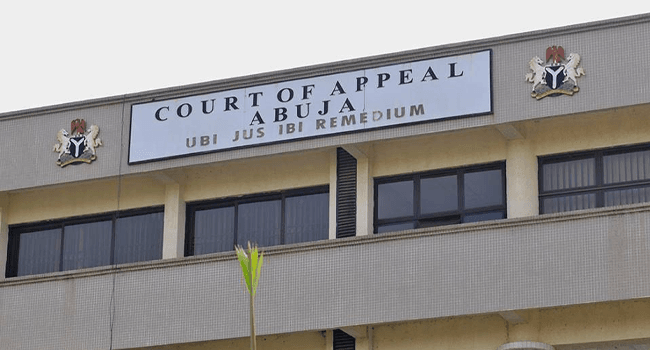
A file photo of the Court of Appeal, Abuja
His remarks came a day after the Court of Appeal in Abuja nullified the Federal High Court judgement directing INEC to deregister the ADC, Action Peoples Party (APP), Action Alliance (AA), Accord Party (AP), and Zenith Labour Party (ZLP).
In a unanimous judgement delivered on Tuesday, a three-member panel of the appellate court held that the June 15 decision of the Federal High Court was a nullity because it was founded on an incompetent suit filed by the National Forum of Former Legislators (NFFL), a body the court held lacked the legal capacity to institute the action.
Justice Abba Mohammed, who delivered the lead judgement, ruled that the trial court wrongly assumed jurisdiction and ignored evidence showing that the affected political parties had won elective positions in previous elections.
The appellate court also faulted Justice Lifu for proceeding with the case despite an earlier order directing him to stay proceedings pending the determination of an appeal.
The court described the trial judge’s action as “a form of judicial impertinence”, noting that the Supreme Court had previously held that a judge who disregards a superior court’s order could be considered “unfit for the bench”, describing such conduct as “judicial rascality.”
The appellate court consequently set aside the deregistration order, restored the legal status of the five political parties, and awarded costs against the NFFL, which had instituted the suit.
Justice Lifu had earlier ruled that the parties failed to satisfy the constitutional requirements for continued registration under Section 225A of the 1999 Constitution (as amended), citing their alleged poor electoral performance in the 2023 general elections and subsequent by-elections. He had also restrained INEC from recognising the parties or accepting candidates nominated by them for the 2027 general elections.
However, the Court of Appeal held that the trial court lacked jurisdiction to entertain the suit and ruled that all the affected political parties remain duly registered.