



From driving economic growth through remittances to advancing innovation, providing leadership, and making life-saving contributions, Nigerians in the diaspora continue to prove that the country’s progress extends far beyond its borders.
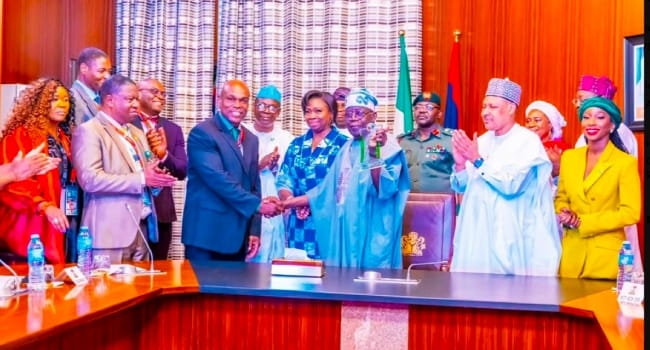
Tinubu received Nigerians in the diaspora at the State House in July, 2026. (Photo by X/@nidcom_gov)
Wherever they go, Nigerians carry more than passports. They carry ambition, expertise, resilience, and an enduring connection to home. Across hospitals, universities, boardrooms, laboratories, courtrooms, and public institutions, Nigerians in the diaspora are shaping industries, earning global recognition, and building bridges that strengthen both their adopted countries and the nation they still proudly call home.
Their impact is measured not only in accolades but also in economic value. In 2025, diaspora remittances exceeded $20 billion, making Nigerians abroad one of the country’s most important economic lifelines. Looking ahead, the Central Bank of Nigeria is targeting $1 billion in monthly diaspora inflows, underscoring the growing importance of Nigerians overseas to national growth and stability.
Yet, beyond remittances lies an even more powerful export: knowledge.
That spirit took centre stage during the 2026 National Diaspora Day Celebration, where President Bola Tinubu welcomed Nigerian medical professionals from around the world who had returned to provide free specialist healthcare, surgeries, consultations, health education and other life-saving interventions across communities nationwide.
Nowhere Like Home
For the President, their homecoming represented more than charity. It reflected a shared belief that global success and national development can go hand in hand.
“It is a very great joy to see that you are coming back to facilitate your single motivation to help your country meet the needs of our people, the medical outreaches; seeing indivisible commitment to humanity is part of your singular oath and commitment in life. I thank all of you,” he said.
Drawing from his own experience of returning to Nigeria after working abroad, Tinubu offered a deeply personal reflection.
“I have been through that journey; I’m home now, and I can tell you there’s nowhere like home. Some people built the society where you are; they have their hands on their plough, their focus was to develop their nation and their continent.”
He urged Nigerian professionals abroad to reconnect with home through partnerships, investment, knowledge exchange and, where possible, permanent return, while reaffirming government efforts to strengthen healthcare through investment in education, research, digital health infrastructure, improved welfare and policies aimed at reversing brain drain.
Nigerians in Diaspora Commission (NiDCOM) Chairman and CEO, Abike Dabiri-Erewa, said the medical professionals had chosen to give back to the country that first nurtured them.
“Your Excellency, the visitors said having been trained in Nigeria and, because they are Nigerians and succeeded abroad, they want to come back home and do something, and that is why we have the diaspora commission encouraging them and working with them to ensure that they play a part in your Renewed Hope Agenda,” said Dabiri-Erewa.
All-Round Excellence
For Nigerians in the diaspora, that commitment extends far beyond healthcare.
Throughout the year, Nigerians continued to break new ground across public service, academia and civic leadership. In the United Kingdom, Councillor Christopher Adegoke became the first person from an ethnic minority background to chair Nottinghamshire County Council since its establishment in 1889, while Rosaline Ogunro assumed office as Mayor of Islington.
Academic excellence also carried the Nigerian flag high. Dorcas Akanbi graduated from Rostov State Medical University in Russia with an outstanding 4.90/5.00 CGPA, while Dr. Monilola Adeshina emerged as valedictorian and best graduating student of the Medical Class of 2026 at the Medical University of Silesia in Poland.
On innovation, Nigerian-American engineer Yinka Ogunbiyi transformed the traditional African art of braiding into a global technology breakthrough with HaloBraid, reportedly the world’s first braid-assist robot. Designed to reduce the physical strain on hairstylists while making braiding faster and more efficient, the innovation has secured $7 million in funding and gained adoption by more than 7,000 salons, highlighting how Nigerian ingenuity is driving practical, world-class solutions with global impact.
Celebrating their achievements, Dabiri-Erewa urged Nigerians to amplify stories of success alongside discussions about the nation’s challenges, saying these accomplishments continue to project Nigeria positively across the world.
At the 2026 National Diaspora Day celebration in Abuja, 32 outstanding Nigerians in the diaspora, organisations, and distinguished individuals were honoured at the 2026 National Diaspora Merit Awards.
‘Naija No Dey Carry Last‘
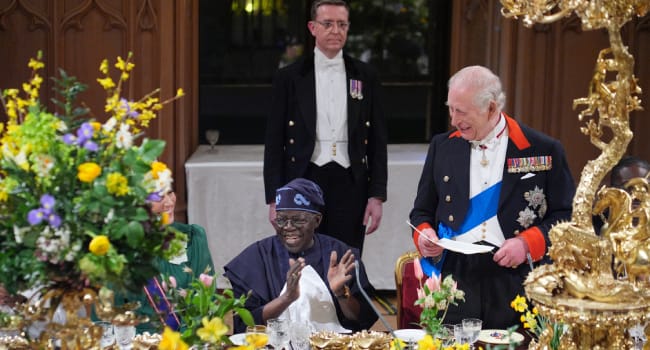
Nigeria’s President Bola Tinubu smiles as Britain’s King Charles III speaks during a State Banquet in St George’s Hall, at Windsor Castle, in Windsor, on March 18, 2026, on the first day of a two-day State Visit to the United Kingdom by Nigeria’s President. (Photo by Yui Mok / POOL / AFP)
Recognition has also come from beyond Nigeria’s borders.
During President Tinubu’s state visit to the United Kingdom, King Charles III praised Nigerians for enriching British society through business, technology, science, academia, law, sports, literature and the arts.
“From Afrobeats filling our concert halls and Nollywood captivating our screens, to stars competing in our Premier League and adjudicating in our highest courts, so much of Britain’s culture is in truth profoundly enriched by Nigerians,” the king said.
With characteristic warmth, the monarch concluded with a phrase that instantly resonated with Nigerians everywhere: “Naija no dey carry last.”
That admiration was reinforced earlier by the prominence of Nigerians in King Charles’ Honours List, where individuals of Nigerian heritage were recognised for outstanding contributions to medicine, education, entrepreneurship, philanthropy, public service and community development.
For Channels Media Group Chairman and CEO, Dr. John Momoh, these achievements point to something even greater than personal success.
“I just want to say: believe in our country, Nigeria. This is the Mecca of the black race. If by 2050 we’re going to be the third or fourth largest country in the world, there will be many challenges, but I think the prospects are greater than the challenges.”
He also left young Nigerians with a message of possibility.
“I think that in each and every one of us, especially the youth among us today, there’s a lion sleeping. All we need to do is wake it up.
“Then we will see that the sky will not be the limit but the starting point for each and every one of us.”
Together, these stories tell a single, compelling narrative: Nigerians abroad are not simply succeeding overseas—they are expanding the country’s global influence, investing in its future, sharing world-class expertise and proving that excellence has become one of Nigeria’s most powerful exports. From remittances that strengthen the economy to innovations, leadership and life-saving service, the diaspora continues to demonstrate that wherever Nigerians thrive, the nation rises with them.