



Thousands of migrants have begun returning to Morocco after crossing into Spain’s North African enclave of Ceuta, with Spanish authorities saying at least 48,000 of the more than 60,000 arrivals in recent days have already gone back.
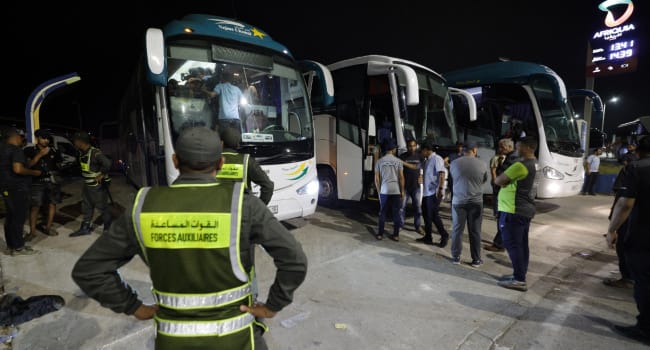
Migrants wait to board coaches as the Moroccan authorities transfer some back to their hometowns after they left Spain’s North African enclave of Ceuta following an attempt to cross at the Morocco-Spain border, at Fnideq in northern Morocco on August 1, 2026.
Thousands of people turned back from the Spanish enclave of Ceuta and returned to Morocco’s Fnideq began boarding buses home on Friday, with the operation continuing on Saturday, according to AFP journalists at the scene.
A Moroccan source close to the operation told AFP on condition of anonymity that the people sent back by Spain are to be transported home directly by bus or via the railway station in Tangier, 70 kilometres (45 miles) away.
According to the source, the Fnideq border crossing is now “completely secure”, as are the hills overlooking it, from which hundreds of people, mostly young men, had thrown stones at security forces on Friday.
The Spanish government announced on Friday evening that at least 48,000 of the 60,000 people who entered Ceuta in recent days, had returned to Morocco.
A Spanish soldier escorts a group of migrants on their way back towards the Moroccan border, following their illegal crossing into the Spanish enclave of Ceuta, on August 1, 2026.
Late Friday, AFP journalists saw around twenty 54-person-capacity buses depart, for a total of about a thousand people.
Fnideq is a small town of just 70,000 inhabitants, roughly equivalent to the population of the enclave of Ceuta, one of Spain’s two North African enclaves.
The buses were headed for Tangier, Tetouan, or the economic capital Casablanca, all equipped with rail facilities to redirect people who had come from as far away as Marrakech, more than 500 kilometres to the south.
“I heard that buses had arrived to take us back home. Honestly, I just want to see my children again. I regret having come all the way here,” said Rachid Aouchari, 32, from Ksar el Kebir, 170 kilometres from Fnideq, who was turned back from Ceuta during the night from Thursday to Friday.

A Spanish soldier uses a megaphone to speak to migrants sitting on the pavement prior to escorting them back to Morocco, in Spain’s north Africa’s Ceuta enclave on August 1, 2026.
Until midday Friday, clashes had pitted the security forces against migrants seeking to cross into Spain, either by swimming or on foot along a narrow wall leading to the Ceuta crossing point.
READ ALSO: Death Toll Hits 67 In Migrant Surge From Morocco To Spain
Police responded with water cannons and tear gas against hundreds of young men, arresting dozens of them, according to an AFP journalist.