



Lede: FCT Minister Nyesom Wike says Governor Siminalayi Fubara’s fallout with him stemmed from abandoning the political structure that brought him to power, dismissing claims that their dispute was motivated by financial interests.
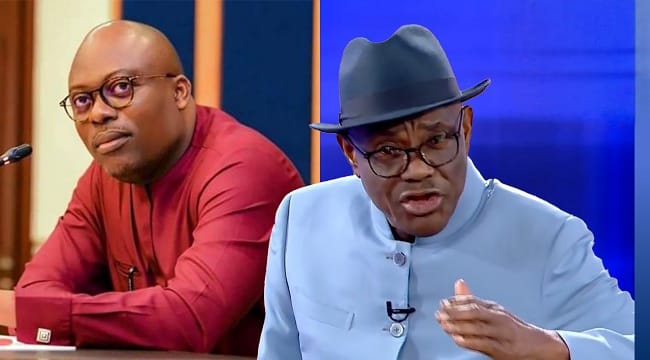
A combo of Wike and Fubara
Minister of the Federal Capital Territory (FCT), Nyesom Wike, has blamed the prolonged political crisis in Rivers State on Governor Siminalayi Fubara’s decision to create a political structure independent of the one that brought him to power, saying the move effectively jeopardised the governor’s chances of securing a second term.
Wike made the remarks on Saturday during a media chat with selected radio stations in Port Harcourt, where he spoke extensively on the breakdown of his relationship with Fubara and the events that led to the political standoff in the state.
According to the former Rivers governor, Fubara began distancing himself from his political base barely 100 days after assuming office, allegedly under the influence of advisers who encouraged him to break away from those who supported his emergence.
“There are people who will tell you all kinds of things and convince you that you no longer need those who helped you get into office. Some even go through family members to pass such messages. The responsibility lies with you to separate good advice from bad,” Wike said.
“His mistake was trying to establish his own structure against the structure that brought him into office, and it happened too early. It started within his first 100 days in office.”
Wike said he had repeatedly advised Fubara to focus on governance and build on the developmental foundations already laid in the state rather than becoming entangled in political battles.
Recalling a conversation during a church service, the minister said he challenged the governor to define his vision for Rivers State and urged him to continue efforts aimed at positioning the state as a competitor to Lagos.
“I told him that he had been elected and needed to decide what he wanted to achieve. My vision was for Rivers to compete with Lagos, and I believed I had laid the foundation for that journey,” he said.
The FCT minister rejected suggestions that their disagreement was driven by financial interests, insisting that his concern had always been the development of Rivers State.
“It was never about money. If it were, we wouldn’t be where we are today. My focus was on governance and ensuring Rivers kept pace with leading states. Unfortunately, he lost focus,” Wike stated.
Addressing speculation about impeachment threats that emerged at the height of the crisis, Wike clarified earlier comments he made on the issue, saying his statement that “there is no sin” was rooted in religious doctrine rather than politics.
He described impeachment as a constitutional and political mechanism that can arise during conflicts between political actors, adding that compromise is sometimes necessary in the interest of governance.
“Everyone makes mistakes. Impeachment is a political instrument and situations can be resolved when parties are willing to put the interests of the state above personal differences,” he said.
Wike also commented on the future of Edison Ehie and other lawmakers who sided with Fubara during the dispute, saying they would have to determine their own political paths following the governor’s reconciliation with his political camp.
According to him, Fubara’s return to the political family that supported his emergence does not automatically guarantee the future of those who aligned themselves with the governor during the crisis.
The minister further argued that recent political developments, including the Supreme Court’s nullification of the local government elections conducted under Fubara’s administration, had weakened the governor’s political standing.
He maintained that Fubara should be more cautious about the counsel he receives, warning that many of those who encouraged confrontation contributed little to resolving the crisis.
Wike also dismissed claims that his involvement in Rivers politics was driven by a desire to control the state, arguing that political structures and alliances are common features of democratic systems worldwide.
Drawing a comparison with political developments in the United States, he said influential political blocs exist in many democracies and should not automatically be interpreted as attempts at domination.
On his relationship with President Bola Tinubu and the emerging political coalition around the president, Wike said they were working towards common political objectives.
“If I support the President and the governor also supports the President, then we are working together,” he said. “We are all working to deliver the candidates of the coalition.”