



The Federal Government says its latest security reforms build on a series of initiatives introduced by President Bola Tinubu to strengthen the Armed Forces and enhance the country’s defence capabilities.
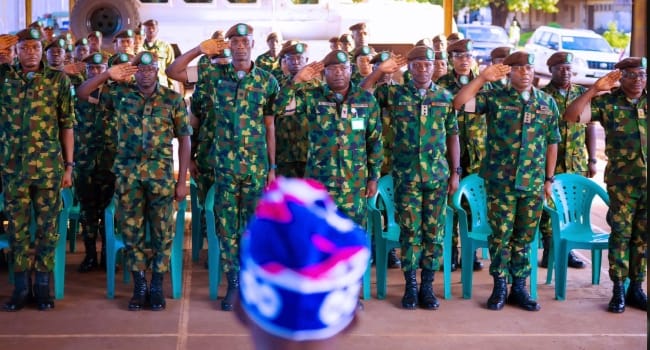
FILE PHOTO: President Bola Tinubu visits the Nigerian Troops stationed in Bissau on Saturday, July 8, 2023, as part of the ECOWAS Stabilisation Force, on arrival at the Aeroporto International Guinea-Bissau ahead of the 63rd Ordinary session of the ECOWAS Authority of Heads of State and Government. (Facebook/PBAT Media Centre)
Strengthening national security increasingly means investing in the people who deliver it. In another major step towards modernising Nigeria’s defence architecture, President Bola Tinubu on Tuesday approved salary increases of between 30 and 80 per cent for about 250,000 members of the Armed Forces, alongside the ongoing expansion of the Nigerian Army and broader investments in troop welfare, operational readiness and force modernisation.
The new salary package, which takes effect from September 1, raises the Armed Forces’ annual wage bill from ₦660 billion to ₦924 billion, with the highest increase targeted at junior personnel serving on the frontlines of the country’s security operations.
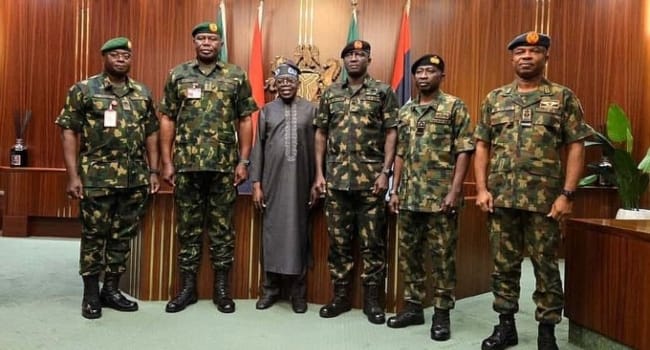
Tinubu poses with Nigeria’s service chiefs (Photo: X@HQNigerianArmy)
The Presidency said the decision recognises the courage and sacrifices of military personnel engaged in the fight against banditry, kidnapping and terrorism across Nigeria.
New Welfare Package
Under the revised salary structure, personnel from the rank of Private to Staff Sergeant will receive an 80 per cent salary increase, while those from Warrant Officer to Colonel will enjoy a 50 per cent increase. Officers above the rank of Colonel—including Brigadier-Generals, Major-Generals, Lieutenant Generals and Generals—will receive a 30 per cent increase.
According to the Presidency, the new package reflects the administration’s determination to place troop welfare at the centre of national security.
“The men and women who help to keep us safe in our homes must be supported and appreciated in the course of their duties to our nation,” President Tinubu said.
He added that the administration would continue modernising the Armed Forces by providing the weapons and technological tools needed to enhance operational effectiveness.
“Our administration believes that no nation can achieve greatness without security,” the President said, urging military personnel to regard the salary review as recognition of their service and sacrifices.
Part Of A Wider Defence Strategy
The salary increase follows another significant reform announced just 13 days earlier—the expansion of the Nigerian Army from eight to 12 divisions.
The restructuring forms part of broader investments that include the recruitment of 28,000 additional personnel, acquisition of critical military platforms and equipment, improved troop welfare and continued support for operational readiness.
Tinubu says the officers and men of the armed forces and other security agencies are working tirelessly and making significant sacrifices to keep Nigerians safe.
The Presidency said the reforms were designed to strengthen Nigeria’s defence capabilities and improve the Armed Forces’ ability to respond to evolving security challenges.
Implementation will take place in two phases, with the establishment of the 5, 9 and 10 Divisions and the reorganisation of existing formations expected to be completed by September 2026. The second phase, which includes activation of the 83 Division, is scheduled for completion by December 2026.
The newly expanded force structure covers all geopolitical zones through division headquarters in Kaduna, Ibadan, Jos, Makurdi, Port Harcourt, Maiduguri, Sokoto, Ilorin, Jalingo, Lagos, Enugu and Benin City.
Military Leadership Welcomes Reforms
Minister of Defence, General Christopher Musa (retd.), described the salary review as a major boost to troop welfare and morale, saying the new package demonstrates President Tinubu’s commitment to supporting military personnel.
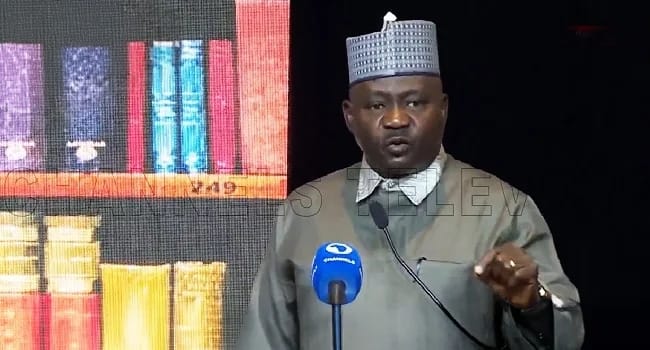
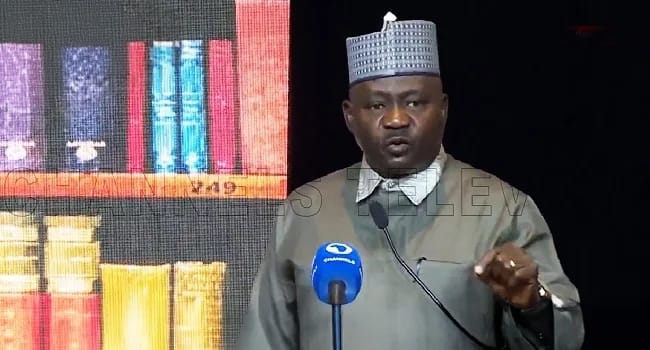
Minister of Defence, Christopher Musa, speaking at ‘The Platform’ in Lagos on Friday, June 12, 2026.
He noted that increasing annual personnel spending from ₦660 billion to ₦924 billion shows that troop welfare remains a priority.
According to him, the improved conditions of service will strengthen morale across operational theatres confronting banditry, kidnapping and oil theft.
The minister also reaffirmed the Ministry of Defence’s commitment to modernising military equipment, expanding technological capacity and improving welfare for personnel and their families.
He urged officers and soldiers to respond with renewed commitment to protecting civilian lives and restoring peace across the country.
Army Activates New Structure
Following the presidential approval, the Chief of Army Staff, Lieutenant General Waidi Shaibu, appointed General Officers Commanding for the newly established divisions.
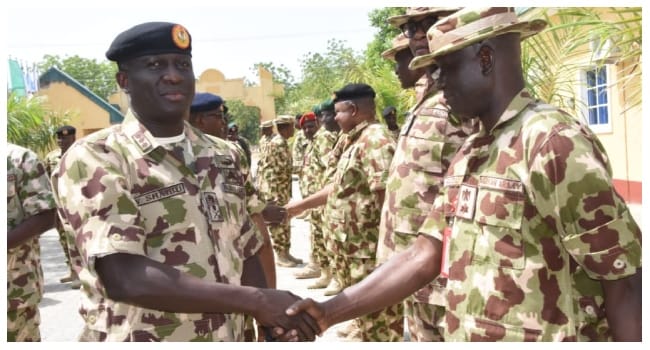
The Chief of Army Staff, Lieutenant-General Waidi Shaibu, greets troops of Operation Hadin Kai, in Maiduguri, Borno State.
The Nigerian Army described the restructuring as a landmark development aimed at expanding its operational footprint, strengthening command and control, improving force projection, and enhancing its capacity to respond effectively to Nigeria’s security challenges.
The new divisions will begin operations once they attain Initial Operational Capability before progressing to Full Operational Capability under a phased implementation plan designed to ensure operational continuity.
Building Long-Term Capacity
The latest reforms build on a series of initiatives announced by President Tinubu during the year to strengthen the Armed Forces.
In March, he pledged to donate all his salaries since assuming office to a welfare fund dedicated to wounded service personnel and the families of fallen soldiers.
In July, he reaffirmed the administration’s commitment to deploying emerging technologies, advanced military hardware and enhanced personnel training to improve operational planning and combat readiness.
Together, the troop welfare package, structural expansion and continued investment in modern capabilities represent another step in Nigeria’s ongoing effort to build a stronger, more capable and better-supported Armed Forces.