


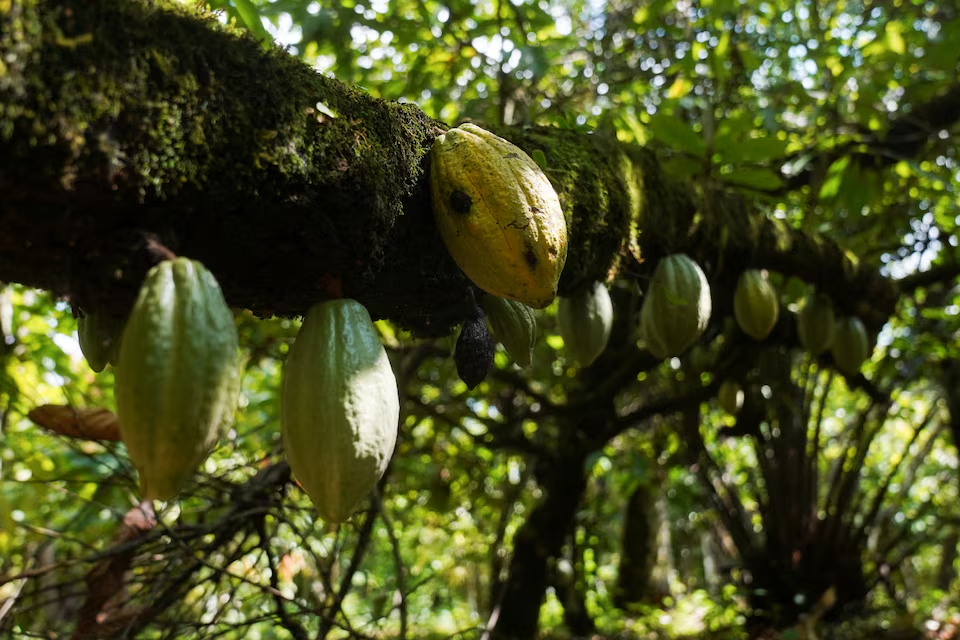
Nigeria’s cocoa industry is facing a major test as the European Union prepares to enforce new rules requiring cocoa exporters to prove that their products are not linked to deforestation.
The rules are due to take effect on December 30, 2026, and will require companies placing cocoa on the EU market to provide information showing where the beans were produced and demonstrating that the farms were not established on land affected by deforestation after the relevant cut-off date. The European Commission lists cocoa among the commodities covered by the regulation.
For Nigeria, the requirement is particularly significant because the country has about 300,000 mostly small-scale cocoa farmers, many of whom operate on remote farms where tracking and documenting production can be difficult.
Industry experts estimate that farmers producing more than half of Nigeria’s cocoa could struggle to meet the EU requirements when the rules become enforceable.
One of the major challenges is farm-level traceability. Exporters need to identify individual farms supplying their cocoa and collect geographical information that can be used to establish where the beans were produced.
A cocoa farmer, Ojo Ayaninuola, in southwestern Nigeria, initially resisted having his farm mapped and geolocated. He later agreed after his buyer, Sunbeth Global, warned that failure to meet the requirements could put his access to the European market at risk.
Some Nigerian exporters have already started spending heavily to prepare their supply chains.
Sunbeth Global said it had mapped about 124,000 hectares of farmland in southern Nigeria over the past three years, covering approximately 60,000 metric tonnes of cocoa in its supply chain. The company said the mapping exercise cost between $30 and $70 per metric tonne.
Another exporter, Starlink Global and Ideal, said it had spent between $40 and $80 per tonne on mapping and tracing its supply chain since 2023.
The additional costs are becoming a concern for exporters because European buyers have been reluctant to absorb the full expense of compliance.
The pressure is also being felt by farmers, particularly those who depend on small-scale cocoa production and have limited access to technology, reliable records and formal systems for documenting their farms.
The issue extends beyond Nigeria. Ivory Coast and Ghana, the world’s two largest cocoa producers, are also working to bring their supply chains into compliance with the EU requirements. West Africa produces roughly 70 per cent of the world’s cocoa, while about two-thirds of the region’s cocoa exports go to the European Union.
Industry experts warn that the new requirements could initially reduce the amount of cocoa eligible for the European market. One estimate cited in the latest reporting suggests that the shortage of compliant cocoa could persist for about two years, potentially giving properly documented cocoa a price premium.
For Nigeria, the stakes are therefore high. Failure by farmers and exporters to meet the requirements could restrict access to a major export market, while successful compliance could give Nigerian cocoa producers continued access to European buyers.
The development is also putting greater pressure on Nigeria’s cocoa industry to improve farm mapping, traceability, documentation and environmental compliance before the December deadline.