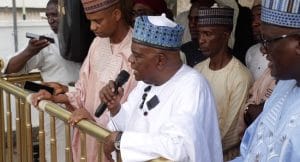




Engineers have called for infrastructure projects to prioritise the needs, safety and wellbeing of the people they are designed to serve.
Nigeria Centre for Disease Control and Prevention (NCDC)
A member of North Central Development Commission (NCDC) representing South West go-political zone, Dr. Atinuke Owolabi, has tasked leaders to prioritise infrastructural development that exists to serve people and make life better.
Atinuke Owolabi argued that a road project is only successful when it improves mobility, reduces travel time and supports economic activity while a power infrastructure is successful when homes, businesses, hospitals, schools and industries receive reliable electricity.
Owolabi led the charge at the 2026 yearly general meeting/conference, award night & induction of new members, entitled: “Sustainable infrastructure development for national growth”, organised by the Nigeria Society of Engineers, (NSE) Bwari Branch.
She said for Nigerian society to move forward, it needs to have engineering infrastructures and projects that would stand the test of time, and be designed to international standards.
Owolabi who doubles as the immediate past chairman, Association of Professional Women Engineers of Nigeria (APWEN), Lagos branch, emphasised that infrastructure development must be linked to the realities of communities as development cannot be approached with a one-size-fits-all model especially in the face of the reality that different communities have different needs, based on geographical conditions, economic opportunities and vulnerabilities.
According to her, infrastructure planning must be data-driven, community-informed and development-oriented.
She said: “A water project is successful when people have sustainable access to safe water. This is why I strongly believe that development must be measured by impact, not merely by projects completed. Poor drainage can destroy livelihoods. Lack of electricity can limit education and entrepreneurship. Poor digital connectivity can exclude communities from opportunities. Inadequate water infrastructure can affect health and productivity. Engineers must always ask: Who benefits from this project? Who might be excluded? How will this infrastructure change lives?.”
Owolabi who was the keynote speaker advised that engineers should be at the centre of national policy and decisions, adding that the nation must embrace greater collaboration, stronger institutions, better implementation and a deeper commitment to infrastructural development as well as sustainability.
She observed that Nigeria does not only have an infrastructure deficit; but also a maintenance deficit, noting that the country sometimes celebrates commissioning of projects more than sustainability.
She charged engineers to insist on whole-life infrastructure planning that include a lifecycle management plan with a maintenance budget.
“Let us design for resilience. Every major infrastructure project should consider climate, future demand, maintenance and risk and engineer green. Sustainability and energy efficiency should become fundamental parts of our designs. Let us move from consuming technology to developing Nigerian solutions, develop people, mentor young engineers, empower women and create pathways for the next generation and measure impact by judging engineering success not only by what we construct, but by the lives and communities we transform,” Owolabi said.
“When we talk about infrastructure, we are talking about the foundation upon which a nation builds its economy, protects its people, creates opportunities and secures its future. The foundation must be strong, resilient, inclusive, environmentally responsible and, above all, sustainable. The infrastructure we design today must not become tomorrow’s burden” she said.
Owolabi urged young engineers to develop technologies that respond to Nigerian problems, especially smart flood-monitoring systems, locally appropriate energy-management solutions and digital platforms for infrastructure monitoring. She said universities, professional institutions and industries must collaborate to commercialise engineering innovations developed locally, while the nation must also move from research publication to research innovation, prototype to commercialisation and impact. These, she said, are how engineering can contribute directly to national development.
Owolabi further warned that any infrastructures being built should not endanger or threaten the lives of the users of the infrastructure.
Earlier, the Chairman, NSE Bwari branch, Funbi Babatunde, stressed that the conversation was necessary to enhance infrastructure sustainability in the country.
The forum also attracted the presentation of awards to the keynote speaker, Dr Owolabi and others as well as the induction of new members into the Bwari branch of the NSE.