


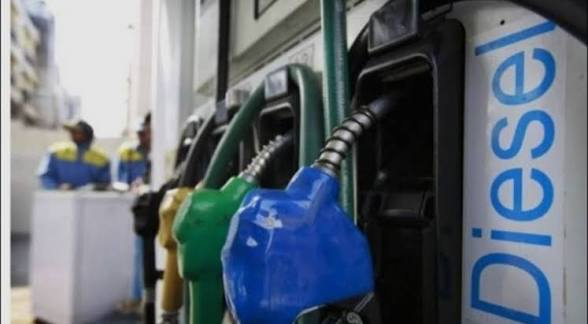
The African Democratic Congress (ADC) has warned President Bola Tinubu over the rising cost of petrol, following reports that the pump price has climbed to N1,470 per litre, deepening concerns over the impact on Nigerians.
Petrol
Asefon blames fuel price hike on Middle East crisis
African Democratic Congress (ADC) has warned President Bola Tinubu over the rising price of petrol, which reached N1,470 per litre in some locations, worsening the economic hardship facing Nigerians.
Also, the Nigerian National Petroleum Company Limited (NNPCL) has, again, increased the pump price of Premium Motor Spirit (PMS), across many of its retail outlets in Abuja and environs.
While many Nigerians blame the removal of subsidy by Tinubu, the National Director of Students Engagement, City Boy Movement, Sunday Asefon, attributed the recent surge in petrol prices to global geopolitical tensions, particularly the conflict involving the United States, Iran and Israel.
ADC said the continued rise in petrol costs was driving up transportation, food, electricity, education, and other essential expenses, pushing households and businesses into severe financial pressure.
In a statement yesterday by its National Publicity Secretary, Bolaji Abdullahi, the opposition party noted that the economic situation had become increasingly difficult for ordinary Nigerians, as families struggled to cope with rising living costs.
The party said the effect of rising petrol prices extended beyond filling stations, noting that higher fuel costs directly affected the movement of people and goods as well as the cost of running businesses.
“President Tinubu has turned the petrol pump into an instrument of punishment for Nigerians,” the party stated.
ADC also raised concerns over reported increases in private school fees, saying some schools increased their charges by 30 to 40 per cent despite incomes failing to rise at a comparable rate.
It said many parents were now being forced to make difficult choices as the cost of fuel, food, rent, transportation and education continued to rise.
“Parents are not earning 40 per cent more. Their salaries have not risen with the prices of fuel, food, rent, transportation and school fees,” the party said.
The opposition party, however, said it did not blame school proprietors for the increases, arguing that they were also contending with higher electricity bills, fuel costs, taxes, rents and staff salaries.
It also warned the ruling All Progressives Congress (APC) against interpreting Nigerians’ resilience in the face of economic hardship as acceptance of the government’s policies, just as it urged Tinubu to take urgent steps to address the rising cost of living, saying the pressure on households and businesses had reached a critical point.
The latest adjustment has pushed petrol prices at some NNPCL stations to as high as N1,430 per litre, further increasing the financial burden on motorists and consumers, who have continued to contend with rising fuel prices.
Checks at NNPCL retail outlets in the FCT showed that petrol was being sold between N1,395 and N1,430 per litre. The new prices represent an increase of between N50 and N80 per litre, depending on the location of the filling station.
The revised prices have been implemented at NNPCL outlets in areas including Airport Junction, Gwarinpa, Kubwa Expressway and Wuse Zone 4, as well as other parts of Abuja and its surrounding communities.
ASEFON, who also serves as Senior Special Assistant to the President on Students Engagement, said the disruption in the global oil market and uncertainty over the strategic Strait of Hormuz exerted pressure on crude oil prices and, consequently, petrol prices in Nigeria.
In a statement entitled, ‘The Pain Is Not From Subsidy Removal, It’s From Geopolitical Tensions Including the War in the Middle East’, Asefon argued that the increase in petrol prices from about N800 per litre at the Dangote Refinery’s gantry to between N1,300 and N1,400 at filling stations could not be attributed solely to the subsidy removal.
“The real enemy is the ongoing global geopolitical tension. The missiles being fired by the United States (U.S.), Iran and Israel are the unseen hands shaping the global oil market,” he said.
The presidential aide said the present global oil market crisis had become a major factor, noting that the Strait of Hormuz, through which a significant proportion of global oil supplies passes, remained critical to international energy prices.
According to him, the Bank of England had warned that a full disruption of the waterway could push global crude prices to between $100 and $130 per barrel.