


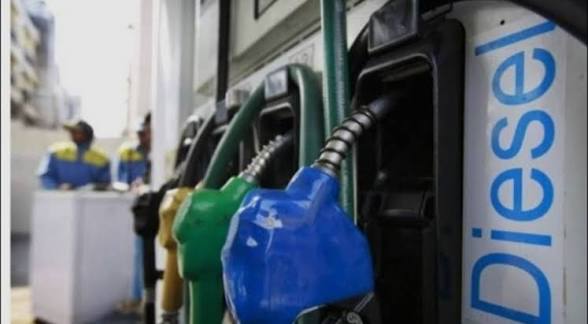
Manufacturers are cutting production shifts as soaring diesel prices push energy costs above 50% of operating expenses, threatening profitability, jobs and the competitiveness of Nigerian businesses.
• N11.3tr petrol bill adds to households’, transporters’ burden
• Firms struggle with over N2,000/litre diesel, cut production shifts
• Rising unsold inventories complicating energy cost pressure
Nigerian manufacturers are grappling with an intensifying energy-cost crisis as spending on diesel and other alternative energy sources now consumes about half of production costs, threatening profitability, competitiveness and survival amid weak consumer demand.
The latest surge in diesel prices to about N2,100 per litre in Lagos and Ogun states, from between N1,700 and N1,800 a few days earlier, has increased the burden on manufacturers that rely heavily on diesel-powered generators because of an unreliable national grid.
The Manufacturers Association of Nigeria (MAN) Director-General, Segun Ajayi-Kadir, said production costs in the sector had risen by more than 400 per cent, with power-related expenses that previously accounted for about 40 per cent of operating costs now exceeding 50 per cent following the sharp increase in diesel prices in the past six months.
As of February, a litre of diesel, used to power manufacturing and haulage operations, sold for about N1,200 in Lagos and Ogun states. Prices have since soared by about 75 per cent, following disruptions to energy markets linked to the Iranian conflict and the recalibration of the pricing methodology by Dangote Petroleum Refinery.
The rising cost of production has significantly weakened the ability of local manufacturers to compete with their peers in other countries for the local market and leverage opportunities under the African Continental Free Trade Area (AfCFTA).
The shortcoming has serious consequences for job and wealth creation. Data from the Nigerian Economic Summit Group (NESG) showed that Nigeria must create about 4.5 million jobs yearly to tackle the wide gap in local capacity utilisation, while other data put the current job-creating capacity at less than one million.
With a population of nearly 240 million, the country has a huge market. But that has become a mere potential that the country must overcome infrastructural constraints to tap.
Manufacturers’ expenditure on alternative energy rose from N782 billion in 2023 to N1.1 trillion in 2024 and further to N1.34 trillion in 2025.
According to MAN, spending in the first half of 2026 alone was already at par with the total recorded in 2025, underscoring the escalating cost of keeping factories running.
Ajayi-Kadir lamented that manufacturers are now facing a dual threat of soaring production costs and rapidly accumulating inventories, directly jeopardising the sector’s target of 3.1 per cent real growth in 2026.
Manufacturing GDP growth was already subdued at 1.13 per cent year-on-year in the fourth quarter of 2025, with pharmaceuticals, metals and food processing among the most affected industries.
The latest spike in diesel prices may have worsened the situation, with manufacturers warning that continued escalation in energy costs could force more firms to reduce production hours, cut jobs or shut down completely.
Executive Director, Universal Luggage Ltd, Frank Onyebu, said the company had been forced to progressively cut its production shifts as the cost of running generators became unbearable.
“We used to run three production shifts. As operating costs went up, the shifts reduced to two, then one, and now every other day. The generators run only for a limited time, when we have orders to supply. Is this how to run manufacturing? Is this how our counterparts in other climes produce?” he asked.
Head of the energy sector at MAN, Ibrahim Usman, said the cost of energy had become the single biggest threat to the survival and competitiveness of Nigerian manufacturers.
“Energy is the most important thing for manufacturers and it pains me to say that in most other climes all over the world, power takes a maximum of 10 per cent of manufacturers’ production costs.
“Unfortunately for us here, power takes over 45 per cent of our production costs and with what is happening now, it may move over 50 per cent, which means a huge chunk of our production costs goes into electricity sourcing.
“There is no way we can be competitive, especially as we are ramping up efforts to export under the AfCFTA. How can we compete with regional and international players that use far cheaper electricity?
“Diesel is the key fuel we use in our production and with the astronomical rise in its cost, there is a huge problem for us.”
Usman said the crisis was particularly painful because Nigeria, an oil-producing country that has increased refining capacity, should not be exposing manufacturers to such high energy costs.
“Even when crude prices went down all over the world, our diesel prices remained high. This is killing businesses, industry and manufacturers,” he said.
He urged the government to intervene urgently in the energy market by reducing diesel costs for manufacturers, supporting renewable energy and accelerating investments in large-scale power generation.
“We must invest in solar farms, especially in the North, which suffers higher fuel prices and has an abundance of sun. In Morocco, a single solar farm produces 1,000MW. Why can’t we have such farms in safe areas across Nigeria?” he asked.
He also called for support for hydropower projects, arguing that underutilised facilities such as the Zungeru hydropower project could provide additional electricity to industrial centres.
According to him, Zungeru has the capacity to provide about 700MW for Kaduna and Kano states, but the potential remains underutilised because of transmission constraints and what he described as government neglect.
“Why didn’t the government put a modern transmission line running through Zungeru, Kaduna and Kano so they can reduce costs? With the extra 700MW added to the grid, this will serve Lagos and other parts of the country.
“Sadly, selfishness, self-centredness and blatant corruption have prevented this from happening,” he decried.
Director-General of the Lagos Chamber of Commerce and Industry (LCCI), Dr Chinyere Almona, said Nigeria’s diesel crisis was quietly dismantling the industrial backbone of the economy.
She noted that diesel, which powers factories, cold chains and small businesses, was now more than double its pre-conflict price, hovering above N2,000 per litre against a pre-crisis baseline of about N900.
“For manufacturers and MSMEs that have no access to the national grid and run entirely on generators, this is not a background cost; it is their single largest operating expense, consuming over 45 per cent of total production costs according to the LCCI Business Environment Journal, 2026,” she said.
Almona warned that the increase in diesel costs was particularly devastating for businesses operating on already-thin margins, as firms that could not absorb the increase were either transferring the cost to consumers or reducing operations.
“A sector that employs over 80 per cent of Nigeria’s non-agricultural workforce is quietly but rapidly contracting,” she said.
She urged the government to introduce a time-bound diesel duty waiver for verified manufacturers and industrial MSMEs, while accelerating the conversion of industrial clusters to compressed natural gas (CNG).
The LCCI chief also advocated the liberalisation of AGO import licensing to improve competition and reduce supply-side pressure.
National President of the Association of Small Business Owners of Nigeria (ASBON), Dr Femi Egbesola, said the high cost of diesel was having a cascading effect across the economy, affecting not only manufacturers but households, transport operators and small businesses.
“For many manufacturers and small businesses, diesel accounts for a significant portion of operating expenses. With the rise in PMS prices, households and businesses are battling to survive.
“The result of this is higher product prices, shrinking profit margins, reduced production capacity and, in some cases, layoffs and business closures,” he said.
The cost of petrol is also taking an increasing toll on households and transport operators.
As of yesterday, PMS prices at most filling stations in Lagos and Ogun had risen to between N1,300 and N1,370 per litre, from about N1,200-N1,220 previously.
The latest increases have been linked to higher crude oil prices and rising wholesale and logistics costs, with Brent crude rising to about $97 per barrel yesterday amid renewed tensions in the Middle East and concerns about disruptions to global oil supplies.
The rising cost has forced motorists to abandon private vehicles for public transportation, while some have resorted to walking to reduce their daily expenditure.
For manufacturers and businesses, however, the bigger concern is that, unlike private motorists who can reduce vehicle use, factories cannot simply switch off their generators without bringing production to a halt.