


State governors have called for greater unity and accountability as Nigeria marks its 66th Independence Anniversary, while highlighting efforts in security, education, healthcare, infrastructure, youth empowerment and poverty reduction.
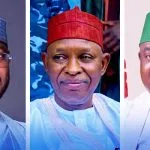
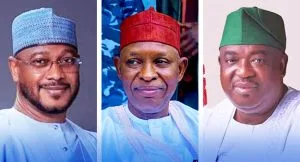
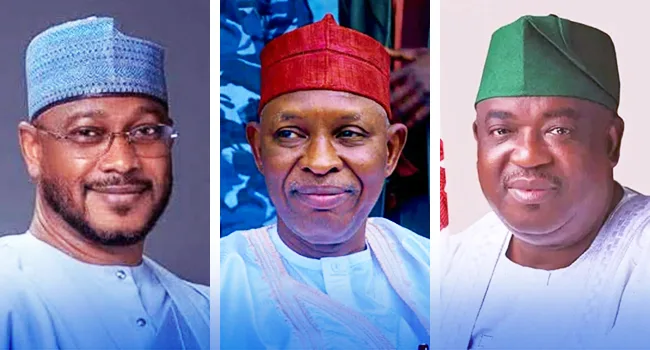
L-R: Governors Dauda Lawal (Zamfara), Abba Yusuf (Kano), and Caleb Mutfwang (Plateau)
Governors across several states have called on Nigerians to sustain unity, peace, patriotism and collective responsibility as the country marks its 66th Independence Anniversary.
In separate messages and addresses to citizens on Thursday, the governors reflected on Nigeria’s journey since independence in 1960, paying tribute to the country’s founding fathers while urging citizens to contribute to national development despite the challenges confronting the country.
The governors also highlighted initiatives and interventions in their respective states, ranging from security, education, healthcare and infrastructure to youth empowerment, poverty relief and the exercise of the prerogative of mercy.
In Kano State, Governor Abba Kabir Yusuf urged residents to shun violence, division, intolerance and criminality, particularly as the 2027 general elections approach.
Yusuf called on political actors, community leaders and citizens to work for peace and security, while urging residents to exercise their civic responsibilities responsibly and pray for a peaceful, free, fair and credible election.
“Let us shun violence and anything that may threaten the peace and stability of our dear state,” he said.
The governor also urged citizens to obey the law, protect public property, pay legitimate taxes and support farmers, traders, teachers, entrepreneurs, women and young people.
In Cross River State, Governor Bassey Otu, represented by his deputy, Peter Odey, urged Nigerians to give deeper meaning to independence by pursuing self-reliance, human dignity and shared prosperity.
Otu described Independence Day as an opportunity for national introspection and renewed commitment to patriotism, integrity, tolerance and collective responsibility.
He said nation-building requires patience, sacrifice, unity of purpose and the determination to transform Nigeria’s potential into tangible prosperity.
The governor also highlighted his administration’s focus on youth empowerment, support for entrepreneurs and agriculture, including loans and grants for farmers, rural feeder roads, mechanisation and the revitalisation of agro-based cottage industries.
Oyo State Governor Seyi Makinde, represented by his deputy, Bayo Lawal, similarly called for unity, regardless of religious or ethnic differences.
Makinde said the sacrifices of Nigeria’s founding fathers should inspire citizens to remain committed to nation-building, stressing that independence also requires adherence to the rule of law and democratic principles.
He said Oyo State had recorded progress in education, security, sports, business and infrastructure since 2019, citing the Amotekun Corps, road networks, education facilities, hospitals and the Light Up Oyo State initiative.
In Taraba State, Governor Agbu Kefas announced a series of measures as part of his Independence Day address, including ₦2.5 billion for vulnerable households, young people and crisis-affected communities.
The package includes ₦500 million for TARABA CARES, ₦1 billion for the Taraba State Youth Development Agency and another ₦1 billion for relief and recovery in Karim Lamido and other crisis-affected areas.
Kefas also announced the exercise of the prerogative of mercy in favour of 24 inmates whose cases had been reviewed.
He said the state would introduce a 168-Ward Quick Impact Development Programme, begin a teachers’ welfare, professionalisation and housing programme in 2027, and develop measures to harness its rivers, lakes, dams and wetlands for fisheries, food security, processing, employment and community livelihoods.
The governor also called for greater transparency in the state’s finances, directing relevant authorities to make available an accessible statement of Taraba’s verified debt position, inherited obligations, repayments and projects financed.
In Nasarawa State, Governor Abdullahi Sule used the Independence celebration, which coincided with the 30th anniversary of the state’s creation, to highlight developments in security, investment, healthcare, education, agriculture and infrastructure since 2019.
Sule said the state had strengthened collaboration with federal security agencies and attracted investments in mining, agriculture and real estate, including two lithium processing companies.
He also listed healthcare interventions, school construction and rehabilitation, teacher recruitment, farm inputs and machinery, as well as the establishment of state farms and the Nasarawa Agro Commodity Company.
Fubara said political differences were normal in a democracy but should not undermine the collective interest of the state.
“We may disagree as politicians, but we must never disagree on the peace and progress of Rivers State,” he said.
The governor urged youths, traditional rulers, political leaders and other stakeholders to become ambassadors of peace in their communities, while calling for continued support for the Federal Government.
Plateau State Governor Caleb Mutfwang also used the anniversary to reaffirm the importance of national unity, sovereignty and collective responsibility.
Mutfwang granted absolute pardon to 130 inmates and commuted the death sentences of four others to life imprisonment.
He urged Nigerians to remain committed to the Nigerian project despite the challenges facing the country, saying its strength lies in citizens’ collective determination to rise above their differences.
In Gombe State, Governor Muhammadu Inuwa Yahaya, who was also marking the state’s 30th anniversary, said his administration would continue to expand economic opportunities and consolidate investments in critical sectors.
He highlighted interventions in education, healthcare, roads, agriculture, industrialisation, environmental restoration, public-sector reforms and youth and women empowerment.
The governor said more than 1,000 kilometres of roads had been constructed or rehabilitated under the Network 11-100 programme and other interventions, while 228 primary healthcare centres had been revitalised.
He also pointed to the development of the 1,000-hectare Muhammadu Buhari Industrial Park and other initiatives under the Gombe State 10-Year Development Plan, DEVAGOM.
In Adamawa State, Governor Umaru Fintiri pardoned nine inmates and commuted the death sentence of another inmate to life imprisonment.
Fintiri also paid tribute to Nigeria’s founding fathers and security personnel, while acknowledging the resilience of Nigerians in the face of economic and social challenges.
He assured the people of Adamawa that ongoing projects initiated by his administration would not be abandoned.