


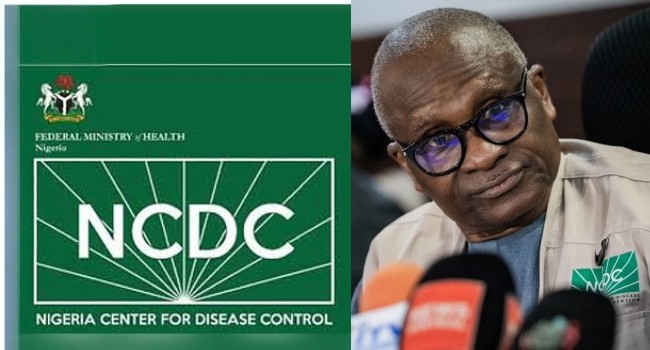
NCDC DG, Dr. Jide Idris (right) said the Presidential Task Force was established primarily to coordinate the national Ebola response, while the NCDC received the ₦10 billion to address wider health security requirements.
The Nigeria Centre for Disease Control and Prevention (NCDC) has said that the Federal Government’s ₦10 billion emergency intervention fund, approved in June 2026 amid the Ebola outbreak in the Democratic Republic of the Congo, was not meant for Ebola alone but to strengthen the country’s preparedness against multiple disease threats.
The agency’s Director-General, Dr Jide Idris, disclosed this in a statement on Monday while addressing questions surrounding the allocation, which attracted public attention following Nigeria’s confirmation of an imported Ebola case in October.
Idris said the funding was requested to improve prevention, preparedness, early detection, rapid response and recovery for diseases of public health importance, including Ebola, Lassa fever, cholera, cerebrospinal meningitis, diphtheria, measles, monkeypox and antimicrobial resistance.
He said the ₦10 billion was released directly to the NCDC and not the Presidential Task Force on Ebola, chaired by the Chief of Staff to the President, Femi Gbajabiamila.
“Was the money released to the Presidential Task Force (PTF) on EVD, chaired by the Chief of Staff to the President? No.
“The PTF was established primarily to coordinate the national response. The ₦10 billion in question was released to NCDC to address the broader health security needs outlined above,” Idris said.
“It is unfortunate that political actors sometimes fail to distinguish responsible opposition from calumny and, in some cases, outright mischief. Health security is a matter of national security and should not be
reduced to partisan contestation.
“Politicians and other public commentators must avoid fuelling infodemics, particularly during public health emergencies when accurate information and public trust are indispensable,” he added.
₦10bn Represents Two Per cent Of Annual Requirement
The NCDC chief, however, said the allocation was inadequate when compared with the country’s broader health security needs, explaining that Nigeria requires an estimated ₦104.4 billion annually to implement its National Action Plan for Health Security (NAPHS) 2.0.
He said that the five-year plan, which runs from 2025 to 2029, has an estimated implementation cost of ₦522 billion.
Idris said the ₦10 billion intervention fund represented approximately two per cent of the plan’s average annual cost, adding that the funding should not be viewed as excessive without considering the scale of Nigeria’s health security requirements.
economic costs on the country.
He maintained that the discussion should not be whether Nigeria could afford to invest adequately in health security, but whether it could afford the human, social and economic consequences of failing to do so.
Nigeria confirmed its first imported case of the Bundibugyo strain of Ebola on October 20, 2026, after a 42-year-old woman who had travelled from Uganda tested positive in Abuja.
Health authorities activated contact tracing, surveillance, quarantine and monitoring measures.
The index patient, who was clinically improved, stable and conscious, was evacuated to Switzerland on October 26 alongside her husband.
The NCDC identified 62 contacts, with monitoring expected to run until November 13.