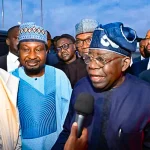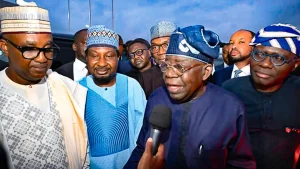



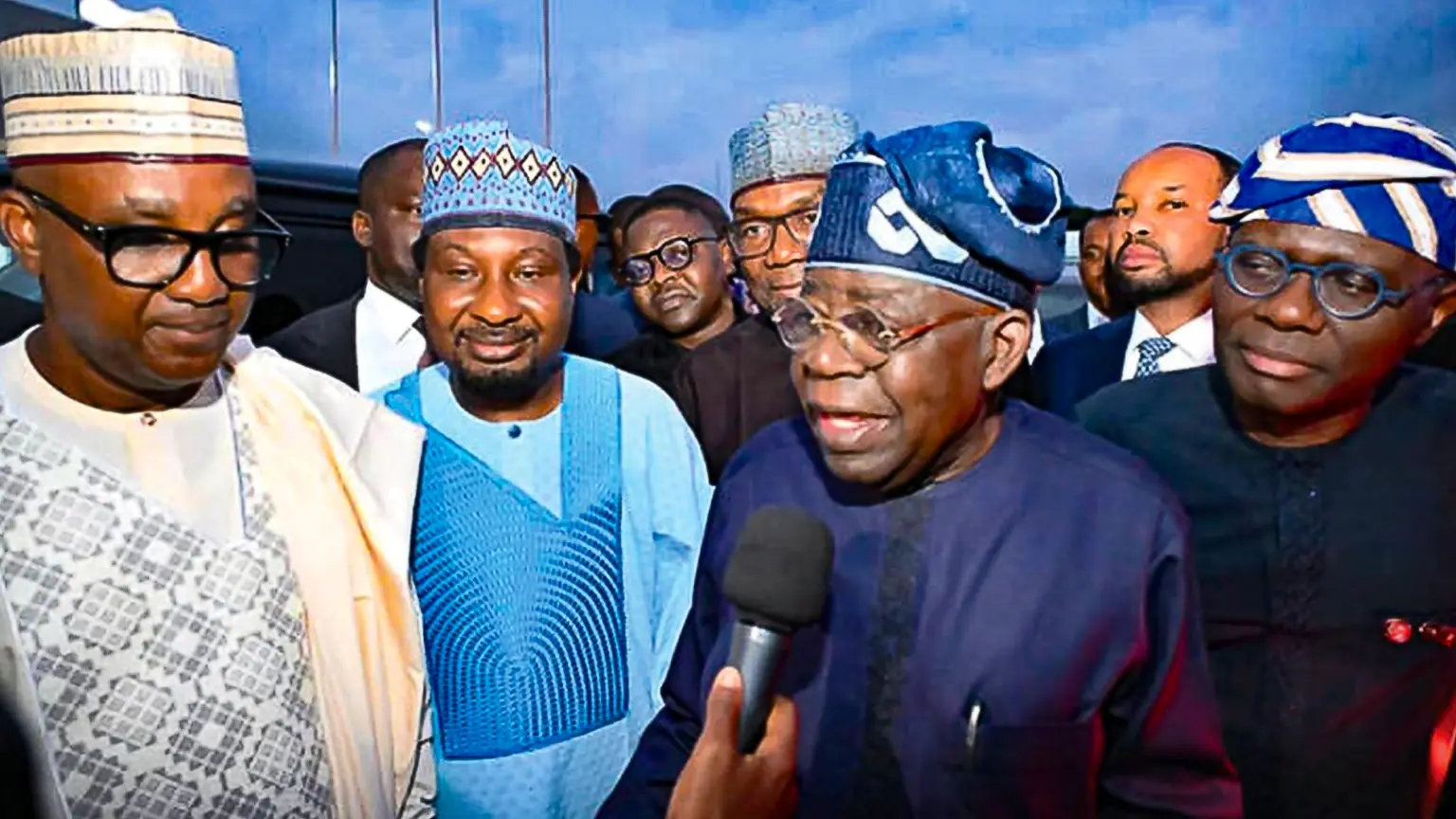
President Bola Tinubu (second right) being welcomed by the Speaker, House of Representatives, Tajudeen Abbas (left); Deputy Senate President, Barau Jibrin and Lagos State Governor Babajide Sanwo-Olu after his working leave to France, at Murtala Muhammed International Airport, Lagos, yesterday.
• Tasks govs as economy grows 4.2% in H1 2026, external reserves hit $53.8b
• Insecurity threatens investment, economic growth – NESG
President Bola Tinubu has cited the World Bank’s latest assessment of Nigeria’s economy as evidence that his administration’s economic reforms are yielding results, even as he acknowledged the need to translate macroeconomic gains into improved living conditions for Nigerians.
The President, who welcomed the bank’s October 2026 Nigeria Development Update, said the findings showed that the economy was stabilising, government revenues rising, and states increasingly directing resources towards infrastructure and other development priorities.
However, the Nigerian Economic Summit Group (NESG) warned that worsening insecurity across the country threatens investment, agricultural production, infrastructure development, and economic growth, and called for coordinated interventions to restore confidence in the economy.
The World Bank report, entitled ‘Beyond the Federal Purse: How Higher Revenues Reshaped State Priorities’, found that Nigeria’s economy grew by 4.2 per cent in the first half of 2026, compared with 3.9 per cent in the corresponding period of 2025, despite the effect of the conflict in the Middle East.
It also noted that the country’s poverty rate stabilised for the first time since 2019, with the bank projecting a gradual decline as economic growth outpaces population growth.
Tinubu said the findings reinforced his administration’s position that the removal of the petrol subsidy, the unification of the foreign exchange market, and efforts to strengthen fiscal discipline were creating the conditions for sustained economic growth.
He acknowledged that more work was required to ensure that the gains translated into tangible improvements in household welfare, particularly through lower food prices, job creation and expanded access to essential services.
“The dividends of reform are becoming visible. But more work remains to ensure they fully translate into better living standards for every household, starting with lower food prices and decent jobs for our young people,” the President said.
According to the Bretton Woods institution, inflation declined from 27.6 per cent in January 2025 to 15.2 per cent in December 2025, although higher global fuel prices associated with the Middle East conflict slowed the pace of disinflation.
The bank projects that inflation will ease to about 12 per cent by 2028, while economic growth is expected to average at least 4.4 per cent between 2026 and 2028.
Nigeria’s external position also improved during the period under review, with the current account surplus rising to $12 billion, equivalent to 7.0 per cent of gross domestic product, in the first half of 2026, from $8.6 billion a year earlier.
Gross external reserves increased from $45.5 billion at the end of 2025 to $53.8 billion at the end of August 2026.
The report further attributed a significant increase in government revenues to reforms introduced since 2023, stating that federation revenues rose by 69 per cent in real terms between 2023 and 2025, with state governments emerging
as the largest beneficiaries.
The additional resources enabled states to increase capital expenditure by 151 per cent in real terms over the same period, with much of the spending directed towards roads and other transport infrastructure, agriculture, energy and housing.
Twenty-nine of the 33 states assessed shifted their spending towards economic infrastructure, while real social spending per capita increased in all but one state.
The bank also reported that internally generated revenue (IGR) grew in real terms in 31 of 35 states, while 21 states reduced their debt-to-Gross Domestic Product (GDP) ratios between 2021 and 2025.
NESG said persistent attacks on farming communities, oil installations, electricity infrastructure and telecommunications facilities were undermining productivity, raising business costs, and discouraging long-term investment.
In a statement yesterday by its Head of Strategic Communication and Advocacy, Ayanyinka Ayanlowo, ahead of the 32nd Nigerian Economic Summit (NES), the group stressed that economic development would remain difficult without improvements in national security.
“Where security fails, productivity collapses, investment retreats and development stalls,” the statement read.
It added that widespread insecurity was increasing Nigeria’s investment risk profile, resulting in higher financing costs, reduced capital inflows and a preference for short-term investments over productive ventures.
According to the group, restoring security would reduce economic losses while signalling to domestic and foreign investors that Nigeria remained a viable destination for long-term capital.
NESG identified agricultural disruptions, crude oil theft, and infrastructure vandalism as major security challenges that are weakening economic performance.
It noted that banditry, terrorism and farmer-herder conflicts displaced millions of agricultural households, particularly across the North-West, North-Central and North-East, reducing cultivated land and worsening food insecurity.
The group cited warnings from the World Food Programme (WFP) and the Food and Agriculture Organisation (FAO) about Nigeria’s severe food insecurity.
It explained that the summit would examine community-based security arrangements, strategic deployment of law enforcement personnel along agricultural corridors and technology-driven early warning systems to restore farming activities.