


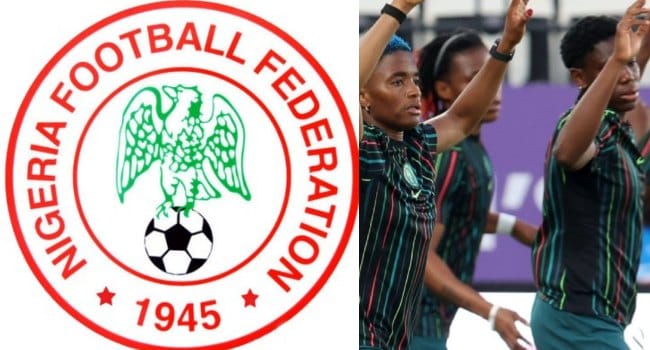
The Nigeria Football Federation has set up a fact-finding committee to investigate the Super Falcons’ failure to qualify for the 2027 FIFA Women’s World Cup, amid growing concerns over the team’s recent poor performances in international competitions.
The Nigeria Football Federation (NFF) has constituted a fact-finding committee to investigate the country’s recent poor performances in international competitions, with particular focus on the Super Falcons’ failure to qualify for the 2027 FIFA Women’s World Cup.
The decision follows Nigeria’s disappointing campaign at the ongoing Women’s Africa Cup of Nations (WAFCON) in Morocco, where the Super Falcons, 10-time champions and defending title holders, were eliminated in the quarter-finals.
Nigeria’s hopes of securing a place at the 2027 Women’s World Cup were further dashed after the Falcons suffered a 2-1 defeat to South Africa in the playoff for a place in the Inter-Confederation Playoffs.
The defeat means the Super Falcons will miss the FIFA Women’s World Cup for the first time since the tournament began in 1991, ending their record of appearing at every edition of the competition.
Announcing the committee on its X handle, the NFF said it would investigate the setbacks suffered by Nigeria’s national teams and recommend measures to prevent a recurrence.
According to the federation, the committee will “investigate the setbacks and make recommendations” on the way forward for Nigerian football.
The NFF said the move was necessary to “identify the factors responsible for the recent poor performances” and develop appropriate recommendations to improve the fortunes of the national teams.
Ambassador Fanny Amun, MON, will chair the committee, while former Super Eagles coach Ladan Bosso, former Super Falcons captain Desire Oparanozie, ex-Super Eagles midfielder Mutiu Adepoju and Dr Alex Mana will serve as members.
Mr Nasiru Jibril has been appointed secretary.
The committee is expected to examine the circumstances surrounding the Super Falcons’ failure to secure a place at the 2027 World Cup, as well as broader challenges affecting Nigeria’s performances in international competitions.
Its recommendations are expected to provide a roadmap for addressing the identified shortcomings and restoring Nigeria’s competitiveness on the international stage.