


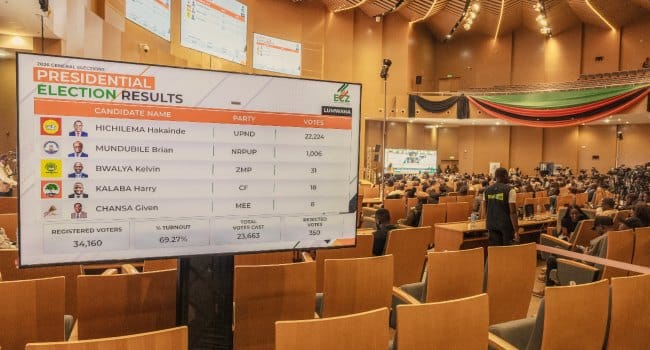
Mundubile finished second in the August 13 vote that handed President Hakainde Hichilema a second term and has vowed to challenge the results in court.
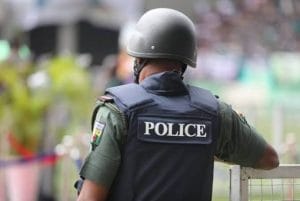
Zambian police summoned opposition leader Brian Mundubile late Thursday for questioning over an alleged national security threat, marking a fresh escalation in the crackdown on dissent that has followed a disputed election.
A joint investigative team said it had been carrying out probes into serious national security threats and wanted to question Mundubile alongside his running mate, Makebi zulu.
The police statement did not specify the nature of the alleged threats, but said “alarming activities” with the potential to undermine national security had occurred at premises linked to the pair.
Police said Mundubile and Zulu had sought refuge “under international law with a known international organisation,” without naming it, and that call-out notices had been served on their advocates.
The summons follows a raid on Mundubile’s Lusaka home last week that forced him to seek protection with the rights organisation, and comes just after immigration officials announced the arrest of the opposition alliance’s secretary general on Thursday.
Authorities have assured the organisation sheltering Mundubile and Zulu that “there is no harm intended to be done on them in any way.”
The summons is the latest chapter in a turbulent aftermath to the August 13 election. Zambia’s election commission declared Hichilema the winner with about 60 percent of votes compared with 38 percent for Mundubile, a result Mundubile has rejected, alleging his campaign documented “serious irregularities, inconsistencies and circumstances surrounding the conduct, counting, transmission and declaration of results.”
The electoral commission had already suspended vote-counting for hours on election night over reports of violence against polling staff and the theft of ballot papers, and Mundubile has confirmed he will challenge the outcome in court.
Tensions reached a violent peak on election night itself.
The government said police arrested 11 people at or near Mundubile’s residence after officers came under fire from the premises, resulting in an exchange of gunfire.
Zambia’s top civil servant, Patrick Kangwa, told the BBC that those arrested were found with high-grade military weapons, ammunition and other materials for an armed insurrection, and had been under surveillance for months, alleging links to foreign nationals and illegal military training camps.
Authorities confirmed that former cabinet minister and opposition MP Mutotwe Kafwaya was shot dead in the raid at Mundubile’s home the day after the vote.
Mundubile has dismissed the government’s insurrection allegations as fabricated and said he is currently “under protection” for safety reasons, without disclosing his location.
The crackdown has drawn sharp international criticism.
UN human rights chief Volker Türk voiced deep concern over the arrests, urging Zambian authorities “to stop arresting people arbitrarily and to uphold fully the due process rights of all those detained,” stressing that detainees must be informed of the reasons for their arrest and given access to legal representation.
Amnesty International has separately warned of a widening crackdown on peaceful dissent, with the organisation’s regional director for east and southern Africa, Tigere Chagutah, calling the reported killing of Kafwaya “deeply alarming” and urging authorities to ensure detainees have immediate access to lawyers, family and necessary medical care.
Once hailed as one of Africa’s most stable democracies, copper-producing Zambia has a long tradition of peaceful transfers of power, with every change of president since the return to multiparty politics in 1991 coming through the ballot box.
But that reputation has come under strain under Hichilema, who took office in 2021, as space for dissent has narrowed and pressure on the opposition has intensified.
Hichilema has denied the election was fraudulent and, after his victory was announced, said criminal charges would be brought against those arrested in the election-night raid.